CD Review
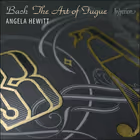
J.S. Bach: The Art of Fugue, Angela Hewitt, piano
- Composer
- J.S. Bach
- Artist
- Angela Hewitt, piano
- Label
- Hyperion
- Catalogue
- CDA67980
Angela Hewitt came to The Art of Fugue late, after she had recorded Bach’s complete keyboard works, and reckons that she needed the experience of her exposure to Bach’s music to find a way through the huge fugues. Her two Edinburgh concerts, where she explained briefly what happened in each contrapunctus, were revelatory in their clarity, and this recording is equally so.
About the work
The Art of Fugue (BWV 1080) is one of Bach’s last major works, composed and revised across the final decade of his life and left incomplete at his death in 1750. It’s built almost entirely from a single musical subject, explored through an escalating sequence of fugues and canons of increasing contrapuntal complexity, simple fugues give way to mirror fugues (playable both forwards and upside-down), triple fugues, and finally the unfinished Contrapunctus XIV. Bach left no instrumentation in the score, and the work wasn’t published until after his death, which has fuelled two centuries of debate over how, and on what, it was meant to be performed. That openness is part of why it keeps attracting fresh recordings: there’s no single “authoritative” version to measure against, only individual musicians working out their own answer to a genuinely open question.
The work’s reputation as a purely abstract, “unplayable” study has softened considerably over the past half-century, as pianists, harpsichordists, organists, string quartets and chamber ensembles have each made a persuasive case for it in their own idiom. Recordings on piano, Hewitt’s among them, tend to foreground the work’s lyricism and long melodic lines rather than treating it as dry counterpoint on the page; the choice of instrument shapes how legible the interweaving voices become to a first-time listener, and how much of the piece reads as a technical exercise versus a genuinely expressive cycle.
From the label
Angela’s much-awaited recording of Bach’s ultimate masterpiece, The Art of Fugue, is destined to be the crowning achievement of her Bach cycle for Hyperion, a revelatory recording and performing project which has taken her all over the world and won her international acclaim and millions of dedicated fans. With decades of experience behind her, she breathes fresh air into the most complex keyboard-writing of Bach, bringing it to life with crystalline clarity and thoughtful sincerity.
About the performer
Angela Hewitt is a Canadian pianist widely regarded as one of the foremost Bach interpreters of her generation. Her complete recording of Bach’s keyboard works for Hyperion, of which this is part, was recorded and released over more than a decade and has become a reference cycle for many listeners coming to this repertoire. Beyond the studio recordings, she has performed the Goldberg Variations, The Well-Tempered Clavier and The Art of Fugue in concert halls internationally, often introducing the music from the stage in the same way she did at the Edinburgh concerts that led directly to this recording.
"Hewitt's eloquent exposition of each fugue's 'formula', the result of a lifetime's immersion in Bach's music, could hardly be bettered." Financial Times
A note on this page
Originally published in mmmusic's own archive and reproduced here as it was written.
Questions about this recording
Is The Art of Fugue written for a specific instrument?
Bach never specified an instrumentation in the manuscript, which is one reason the work has been recorded on solo keyboard, by string quartets, and by full ensembles. Angela Hewitt's recording presents it on piano.
Why does the piece sound unfinished at the end?
Bach died in 1750 before completing the final fugue, Contrapunctus XIV, which breaks off mid-phrase shortly after a passage built on the B-A-C-H motif (a musical spelling of his own name in German note names). Most recordings, including this one, present the work as Bach left it rather than using a later completion.
What order are the movements performed in?
There's long-standing scholarly debate over Bach's intended performing order for the contrapuncti and canons, the surviving sources don't settle it definitively. Like most performers, Hewitt makes her own considered choice rather than following one uncontested sequence.
Is this recording still available to buy?
Yes, Hyperion's CDA67980 remains in catalogue. We don't run an in-house shop, so we link out to Amazon and Discogs below rather than sell it directly.


