 Back
Back The counter
Best turntables, and a proper setup guide that actually works.
Buying guides, setup notes and the accessories worth actually spending on, tested against what a first-time buyer really needs.
Which of these guides you actually need
The three guides above cover three different starting points, not three versions of the same advice. The buying guide is for someone who doesn't own a turntable yet and wants to understand what separates a good one from a bad one before comparing models, drive type, cartridge, phono stage, the things a spec sheet doesn't explain on its own. The budget guide takes those same fundamentals and applies them specifically to what's realistic under £200, where the trade-offs are tighter and it matters more which corners get cut. The setup guide is for after the purchase: getting a turntable that's already sitting on a shelf to actually sound the way it should.
What actually separates a good turntable from a bad one
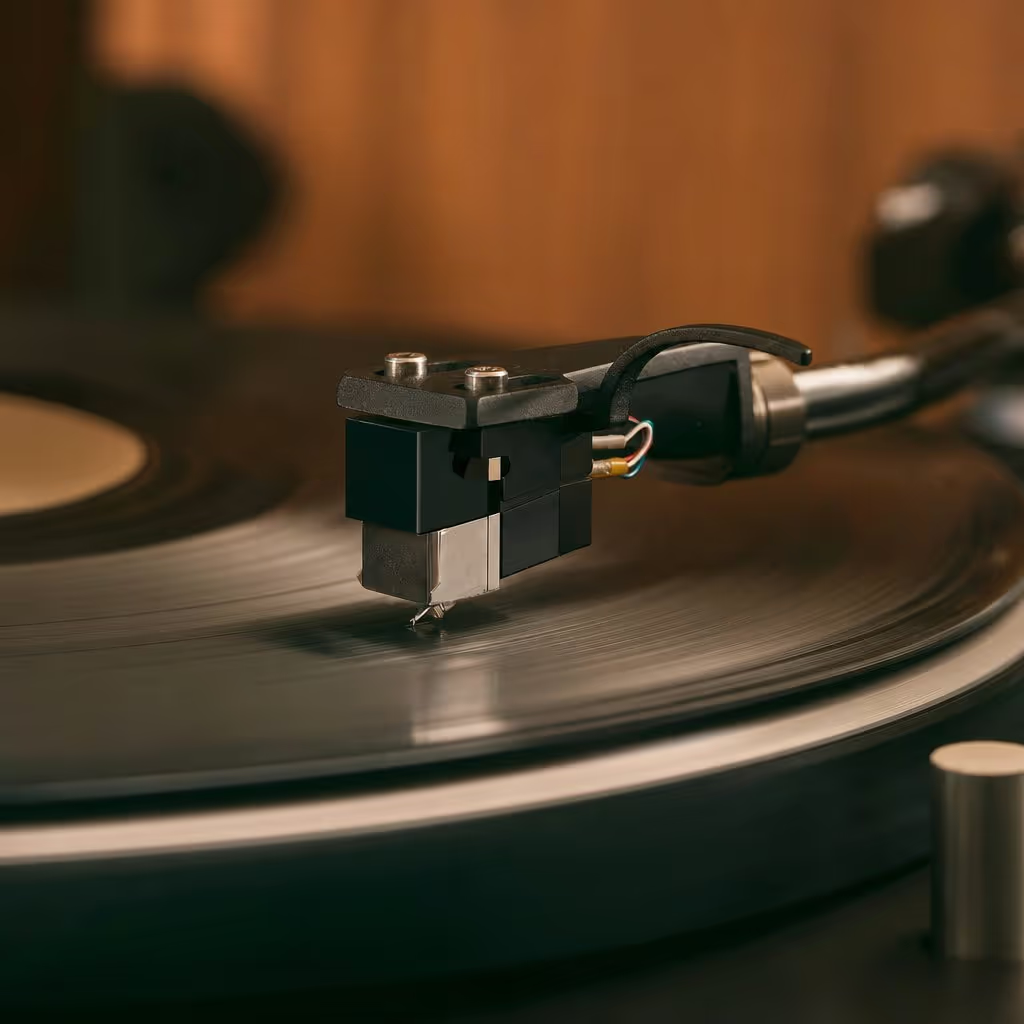
Three things do most of the work, in roughly this order of importance: the cartridge and stylus, which physically read the groove and have an outsized effect on sound quality relative to their cost; the drive type, where belt-drive mechanically isolates the platter from motor noise and is the better default for home listening, while direct-drive trades that isolation for the instant start-up torque a DJ actually needs; and the phono stage, the small preamp that boosts and re-equalises a turntable's unusually quiet signal before it reaches a normal amplifier input. Get the phono stage wrong, missing entirely, or switched off when the amp has no dedicated phono input, and a turntable that's correctly connected in every other sense will still sound thin, quiet or distorted. It's the single most common reason a "properly wired" turntable disappoints on the first play.
None of this is really about spending more for its own sake. A genuinely competent first turntable, with a real cartridge and a stable platter, is available well below the price of most "premium" all-in-one units that trade sound quality for built-in speakers and Bluetooth convenience, which is a reasonable choice for casual background listening, just not for anyone who cares how the record actually sounds. The budget guide above goes through exactly where that competent floor sits right now.
Buying to upgrade later, versus buying once
Worth deciding on purpose rather than by accident: a turntable built around a standard, user-replaceable cartridge and headshell costs a little more up front but keeps the single most impactful upgrade, a better cartridge, available without replacing the whole turntable later. An all-in-one unit with a fixed cartridge accepts a hard ceiling on future sound quality in exchange for a lower price and one less thing to think about. Neither is the wrong choice, but someone who plans to upgrade eventually needs the first kind from day one; the "suitcase" turntables covered in the budget guide generally can't be upgraded into that category after the fact.
Where a turntable sits in the room matters more than it seems
A turntable is a mechanical instrument reading a physical groove, which makes it more sensitive to its surroundings than most other hi-fi components. Placed too close to speakers, especially on the same shelf or a shared wall-mounted unit, it can pick up acoustic feedback, the speakers' own output vibrating back through the shelf and into the stylus, which shows up as a low rumble or, at extreme volumes, audible howling. A stable, level surface away from foot traffic and ideally not sharing a structure with the speakers avoids this entirely; a dedicated stand or a solidly built piece of furniture does the job better than a wobbly shelf, regardless of how good the turntable itself is.
The other half of "where it sits" is what it's plugged into. A turntable's phono output needs a genuine phono input on the amplifier, or an outboard phono stage between the two, connecting it to a normal line-level input (aux, CD, tape) skips the RIAA equalisation the signal needs and produces something thin and wrong, not just quiet. Worth checking before buying speakers or an amplifier to go with a new turntable, not after, since it's a much easier problem to solve at the planning stage than to diagnose afterwards.
Vintage decks are worth a specific mention, since they're a genuinely different buying process from anything new: a well-kept linn turntable for sale secondhand can outperform a much pricier new all-in-one unit, provided the belt, cartridge and tonearm bearings have actually been checked rather than assumed fine from age alone. For anyone building the listening habit rather than the equipment first, a genuinely good how to listen book played through the same system is a useful way to learn what a setup actually sounds like on spoken word before judging it on music, and a specific pressing like Mac Miller's Faces on vinyl is a reasonable modern test record for tracking weight and cartridge alignment once the deck itself is sorted.
Turntable questions people actually ask
I've got a 'plug and play' turntable, do I still need the setup guide?
Usually yes, at least the first few minutes of it. "Plug and play" almost always means the electronics are pre-wired, not that the mechanical setup is done for you, the counterweight, anti-skate dial and cartridge guard are still shipped loose or capped on most models, and leaving them unset is one of the more common reasons a new turntable sounds thin or skips. The setup guide is short precisely because most of what it covers is a five-minute once-over, not a project.
What's actually different between the buying guide and the budget guide here?
The buying guide covers the fundamentals that apply at any price, drive type, cartridge, phono stage, so you know what you're comparing before you look at a single model. The budget guide takes those same fundamentals and applies them specifically to what's realistic under £200, where the trade-offs are tighter and a couple of corners usually do get cut somewhere. Read the buying guide first if you're not sure what any of those terms mean yet.
How long does setting up a first turntable actually take?
For most belt-drive models with a pre-mounted cartridge, well under half an hour: unboxing, fitting the platter and belt, levelling the plinth, setting tracking weight and anti-skate to the cartridge manufacturer's spec, and a test play. A turntable that needs the cartridge mounted from scratch (rather than pre-fitted to the headshell) takes longer and is a fiddlier first project, worth knowing before buying if you'd rather not deal with it.
Is a USB turntable, for digitising an existing collection, worth it as a first turntable?
It depends on the goal. A USB turntable is a genuine convenience if digitising records for a phone or laptop is the actual priority, but that USB stage is usually built around cost rather than sound, so the same money spent on a non-USB turntable with a better cartridge tends to sound noticeably better for ordinary listening. Worth deciding which matters more before buying, since it's not usually possible to have the better version of both at the same price point.