CD Review
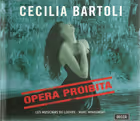
Various composers: Opera Proibita, Arias by Handel, A. Scarlatti & Caldara
- Composer
- Handel / A. Scarlatti / Caldara
- Artist
- Cecilia Bartoli, mezzo-soprano; Les Musiciens du Louvre / Marc Minkowski
- Label
- Decca
- Catalogue
- 475 6924
- Reviewed by
- Anne McAlister
Cecilia Bartoli; Les Musiciens du Louvre / Minkowski, Decca 475 6924, released October 2005.
The arrival of the 18th century in Rome, that centre of cultural excellence, saw all theatres closed and opera banned for both religious and political reasons. Yet powerful, wealthy patrons were eager to support and encourage the composers attracted to the city. Thus was born the Italian oratorio, an opera-substitute (generally shorter) in which only sacred or allegorical figures could be portrayed. With fewer arias and recitatives, oratorio made use of music and stories of much greater intensity, designed to hold the audience’s attention with virtuosic performance.
Cecilia Bartoli, a native of Rome, has obviously delighted in her latest project, mining the archives for works by three composers working in Rome during that first decade whose output at that time represents the pinnacle of this flourishing genre. Eight of the 15 arias on this disc are world-premiere recordings, the selection ranging from Francesca’s exquisite lament on the death of her husband (Caldara’s Oratorio per Santa Francesca Romana) to Peace’s bellicose demands for weapons to fall silent (Scarlatti’s Cantata per la Notte del SS.mo Natale).
Caldara, born in Venice, was maestro di cappella for Prince Ruspoli in Rome from 1708 to 1716; his arias show the same touching beauty and sweetness that are particularly evident in René Jacobs’ recording of Maddalena ai piedi di Cristo, although Caldara is more than capable of creating musical fireworks too, as Flavia’s aria on track five amply demonstrates.
Alessandro Scarlatti divided his working life between Naples and Rome, writing dozens of operas and oratorios and hundreds of cantatas. The variety and inventiveness in his compositions is striking; the breezy jauntiness of Ismael’s aria Doppio affetto is in complete contrast to Hope’s aria from Il Giardino di Rose, a somnolent evocation of summer where time almost stands still.
Handel’s arias are drawn from his two Italian oratorios La Resurrezione and Il Trionfo del Tempo e del Disinganno, with Ms Bartoli giving a heart-rending performance of Pleasure’s aria Lascia la spina from the latter (modelled on an instrumental saraband from his opera Almira). Soloist and orchestra are in astonishingly dazzling form throughout this wonderful and intriguing disc. Don’t miss it!
A note on this page
Originally published by Anne McAlister, recovered from mmmusic's own archive and reproduced here as the critic wrote it.
Questions about this recording
Why is this album called Opera Proibita, 'forbidden opera'?
In the early 18th century Rome's theatres were closed and opera itself banned for religious and political reasons, so composers working there turned instead to the Italian oratorio, a shorter, opera-substitute form permitting only sacred or allegorical characters.
Are any of these recordings premieres?
Yes, 8 of the disc's 15 arias are world-premiere recordings.
Which oratorios are the Handel arias drawn from?
La Resurrezione and Il Trionfo del Tempo e del Disinganno, the latter including Pleasure's aria Lascia la spina, modelled on an instrumental saraband from Handel's opera Almira.
Is this recording still available to buy?
Yes, Decca's catalogue number 475 6924 remains widely available through classical retailers. We don't run an in-house shop, so we link out to Amazon and Discogs below.


