CD Review
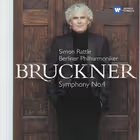
Bruckner: Symphony No. 4, Berlin Philharmonic Orchestra / Rattle
- Composer
- Bruckner
- Artist
- Berlin Philharmonic Orchestra / Rattle
- Label
- EMI
- Catalogue
- 3 84723 2
- Reviewed by
- Sandy Matheson
During his time in Birmingham, Simon Rattle was a highly selective Brucknerian, restricting himself to the Fourth and Seventh Symphonies, the latter being programmed with some frequency. The Seventh, a studio taping made in 1996, was one of his last recordings as Music Director of the CBSO. It’s one of the most beautiful Bruckner recordings ever to have been made with a British orchestra, but in a way that’s its problem, it seems over-concerned with the highly-buffed surface of the music, especially in the great Adagio. The new Fourth is far superior in this respect, in part due to the long experience of the Berliners in this repertoire.
For the most part this is a glorious account of Bruckner’s most endearing symphony. The opening movement is clear-sighted and magnificently achieved by the Berliners. The brass playing has tremendous power, and yet never sounds merely forceful, while Rattle is careful not to overplay the climaxes. In this performance, the brass are rarely let off the leash; when they are (try the Scherzo around 0’26”) it is with humorous effect, Rattle is one of rather few conductors on record to have fun with the Scherzo. He follows Klemperer (the source is Robert Haas’s 1944 edition) in reversing the flute and oboe parts in the Trio, a nice idea which I wish other conductors would take up. (In the Scherzo, he also makes sure that the triplets are absolutely precise, which is much rarer than you might think.)
Rattle is far from the first conductor to be somewhat foxed by the structurally rickety Finale. It’s very hard to find an overarching tempo that will successfully encompass the disparate events as Bruckner presents them, and Rattle’s solution of employing multiple tempos further weakens an uneven movement. He’s also quite at a loss to know what to do with the weird passage from Figure P onwards, his manic acceleration (from 16’25”) comes out of nowhere, although admittedly this passage is hardly Bruckner’s strongest idea. From then on Sir Simon doesn’t put a foot wrong, bringing the work home with a perfectly weighted coda (one of Bruckner’s very finest).
Klemperer, in his superb 1965 Philharmonia recording (also for EMI), gets around this particular “finale problem” by cheerfully ignoring Bruckner’s nicht zu schnell (“not too fast”) tempo indication, and steaming through it in a remarkably speedy 18’59” (Rattle takes a more conventional 23’48”). At the other extreme of the interpretative scale, Sergiu Celibidache, in his 1988 Munich recording, makes a strong case for interpreting the movement as an Adagio. (The unkind among us might point out that he interpreted almost everything as an Adagio, but his chosen tempo really works here.)
Despite my reservations about Rattle’s Finale, I’ll want to return to him for his affectionate, attractively human-scaled approach to Bruckner, and for the peerless playing of the Berliners.
A note on this page
Originally published by Sandy Matheson, recovered from mmmusic's own archive and reproduced here as the critic wrote it.
Questions about this recording
Which Bruckner symphonies did Rattle record during his Birmingham years?
Only the Fourth and Seventh, the review notes he was a highly selective Brucknerian at the CBSO, with the Seventh (a 1996 studio recording) becoming one of his last recordings as the orchestra's Music Director.
What edition of the Fourth Symphony does this recording use?
Robert Haas's 1944 edition, Rattle follows Klemperer's example of reversing the flute and oboe parts in the Scherzo's Trio, a detail the review highlights as an idea it wishes more conductors would adopt.
Is the Finale considered a strong point of this recording?
The review is more critical here than elsewhere, it calls the Finale structurally 'rickety' and finds Rattle's use of multiple tempos only partly successful, though it praises the closing coda as one of Bruckner's finest.
Is this recording still available to buy?
Yes, EMI's catalogue number 3 84723 2 remains findable through classical retailers. We don't run an in-house shop, so we link out to Amazon and Discogs below.


