CD Review
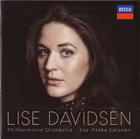
Wagner, R. Strauss: Wagner & Strauss: Debut Recital
- Composer
- Wagner, R. Strauss
- Artist
- Lise Davidsen, soprano; Philharmonia Orchestra / Esa-Pekka Salonen
- Label
- Decca
- Catalogue
- 483 4883
Lise Davidsen’s self-titled 2019 debut recital for Decca did something no operatic soprano’s first commercial recording had done before: it reached No. 1 on the UK Official Classical Albums Chart on release. That’s a genuinely unusual outcome for a programme built entirely around Wagner and Strauss, repertoire that demands a voice large and steady enough to sit comfortably over a full orchestra, not the kind of material that typically drives chart placements. The disc paired the Norwegian soprano with the Philharmonia Orchestra under Esa-Pekka Salonen, giving her Decca debut real conductorial weight from the outset.
About the programme
The recital draws from two Wagner arias from Tannhäuser, “Dich, teure Halle,” the opera’s exuberant Act II entrance aria for Elisabeth, and “Allmächt’ge Jungfrau,” her prayer from Act III, alongside “Es gibt ein Reich” from Strauss’s Ariadne auf Naxos, four individual Strauss songs including “Wiegenlied” (Lullaby) and “Malven,” and Strauss’s Four Last Songs, one of the most demanding and frequently recorded works in the soprano repertoire. The programme deliberately concentrates on a narrow, closely related vocal territory, Wagner and Strauss both wrote for what’s often called the dramatic or jugendlich-dramatischer soprano voice, music that needs both power and sustained lyrical control across long orchestral textures. Choosing to build a debut around exactly that repertoire, rather than a broader recital spanning multiple styles, was as much a statement about voice type as about repertoire.
About the performer
Davidsen’s career since this recording has confirmed the promise the chart placement suggested at the time: she’s gone on to sing leading Wagner and Strauss roles at the Metropolitan Opera, the Royal Opera House, Bayreuth and other major houses, establishing herself as one of the defining dramatic sopranos of her generation. Esa-Pekka Salonen, a conductor as well known for his own compositions as for his podium work, leads the Philharmonia Orchestra with the kind of clarity and control that lets a still-emerging voice sit forward in the balance without being overwhelmed, which matters considerably on a recording meant to introduce a singer rather than showcase an established interpretation.
About the voice type
Wagner and Strauss both wrote their most demanding soprano roles for what’s generally described as a dramatic or jugendlich-dramatisch voice, one capable of real vocal weight and carrying power across a full orchestra, but still retaining lyrical flexibility rather than pure force. It’s a comparatively rare voice type, and singers who possess it convincingly are often identified early and tracked closely by opera houses and labels alike, since the repertoire that suits them, Isolde, Brünnhilde, the Marschallin, Ariadne, sits at the centre of both composers’ most substantial works. Building a debut recital explicitly around this repertoire, rather than a broader, safer recital spanning multiple lighter styles, was as much a public declaration of voice type as a conventional showcase, and one that subsequent casting at major houses has borne out.
A note on this page
This is a freshly written review of a real, current recording rather than part of the site’s recovered 1991–2018 archive, mmmusic’s original site had already closed by the time this record topped the charts. It extends the same kind of factual, source-checked coverage the shop used to publish to a release made after the shop itself stopped operating.
Questions about this recording
What's on Lise Davidsen's debut recital?
Two Wagner arias from Tannhäuser ("Dich, teure Halle" and "Allmächt'ge Jungfrau"), "Es gibt ein Reich" from Strauss's Ariadne auf Naxos, four of Strauss's songs including "Wiegenlied" and "Malven", and Strauss's Four Last Songs, with the Philharmonia Orchestra under Esa-Pekka Salonen.
What makes this chart placement unusual?
It reached No. 1 on the UK Official Classical Albums Chart on release in 2019, making Davidsen the first operatic soprano to top that chart with a debut recital.
Who is Lise Davidsen?
A Norwegian dramatic soprano who has since become one of the leading voices of her generation in heavy Wagner and Strauss repertoire at major houses including the Metropolitan Opera and the Royal Opera House, this recital is her first commercial recording.
Why pair Wagner and Strauss on a debut disc?
Both composers write for the same kind of large, dramatic soprano voice capable of cutting through a full orchestra, a natural pairing for a singer establishing her voice type and range on record for the first time.
Is this recording still available to buy?
Yes, Decca's catalogue number 483 4883 remains findable through classical retailers. We don't run an in-house shop, so we link out to Amazon and Discogs below.


