CD Review
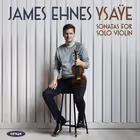
Eugène Ysaÿe: Six Sonatas for Solo Violin, Op. 27, James Ehnes, violin
- Composer
- Eugène Ysaÿe
- Artist
- James Ehnes, violin
- Label
- Onyx Classics
James Ehnes’s recording of Eugène Ysaÿe’s Six Sonatas for Solo Violin, Op. 27, released on Onyx Classics in April 2021, was named a Gramophone Editor’s Choice within months of release and went on to win the magazine’s Instrumental Award at the 2022 Gramophone Classical Music Awards. It’s a cycle with a genuine claim to being the definitive unaccompanied-violin showpiece of the 20th century, and one that leaves a soloist with nowhere to hide.
About the sonatas
Ysaÿe, a Belgian violinist and composer, wrote his Six Sonatas for Solo Violin in 1923, reportedly inspired after hearing Joseph Szigeti play Bach’s own solo violin works, a lineage the set makes explicit, since it’s frequently discussed as the most significant addition to the unaccompanied-violin repertoire since Bach. Each of the six sonatas is dedicated to a different real violinist among Ysaÿe’s own contemporaries, including Jacques Thibaud, Fritz Kreisler, George Enescu and Jascha Heifetz, and each is written, by reputation, to reflect something of that particular violinist’s own technical and interpretive personality, giving the six sonatas a distinct character from one to the next despite being a single unified opus.
About the performer
James Ehnes, a Canadian violinist with an extensive international solo and chamber-music career, brought this cycle to disc with an established reputation for exactly the kind of technical control and interpretive clarity that unaccompanied Ysaÿe demands, playing with no accompaniment to share the musical argument, every structural and expressive decision across all six sonatas rests entirely on the soloist. That’s a genuinely exposed format even for an experienced player, which is part of why a fully achieved recorded cycle is relatively rare and closely watched by critics and fellow violinists alike.
Why this recording stood out
Gramophone naming the disc an Editor’s Choice within two months of release, before it went on to take the Instrumental Award outright the following year, points to a recording that impressed specialist critics from first hearing rather than growing into its reputation slowly. For a cycle as frequently recorded and as closely scrutinised as Ysaÿe’s solo sonatas, winning a top prize requires a genuinely distinctive account of all six sonatas’ contrasting characters, not just secure technique, which by this level of professional recording is close to a given, but a real interpretive personality across the whole set.
The Bach connection
Ysaÿe’s own inspiration for the set, hearing Szigeti play Bach’s unaccompanied violin works, matters for how the sonatas are usually approached on record. A performer recording the cycle is implicitly inviting comparison not only with other Ysaÿe recordings but with the entire tradition of solo Bach playing that the set was written in dialogue with, since Ysaÿe deliberately wrote music that could stand as a 20th-century answer to Bach’s Sonatas and Partitas rather than something in an entirely separate tradition. A convincing account has to hold its own against both lineages at once.
A note on this page
This is a freshly written review of a real, current recording, extending mmmusic’s critical coverage to what’s actually being recorded and recognised today, it isn’t part of the site’s recovered 1991–2018 archive. Every fact here has been independently verified; we weren’t able to pull a full Discogs catalogue-number and pressing-detail snapshot for this title at the time of writing, so those fields are left out rather than guessed.
Questions about this recording
Who was each of Ysaÿe's six solo violin sonatas written for?
Each of the six sonatas is dedicated to a different real violinist of Ysaÿe's own era, among them Jacques Thibaud, Fritz Kreisler, George Enescu and Jascha Heifetz, with the writing in each sonata reportedly shaped to reflect that dedicatee's own playing style.
Why is playing unaccompanied violin sonatas especially exposed?
With no accompaniment to share the musical texture or cover any unevenness, every intonation, phrasing and structural decision is entirely the soloist's alone, a genuinely demanding format that leaves nowhere to hide, which is part of why a cycle like this is closely scrutinised by critics and other violinists alike.
When was this recording released, and how was it first received?
Onyx Classics released it in April 2021, and Gramophone named it an Editor's Choice the following June, ahead of it going on to win the magazine's Instrumental Award the following year.
What did this recording win?
The Instrumental Award at the Gramophone Classical Music Awards 2022.
Is this recording available to buy?
Yes, it remains available through Onyx Classics and classical retailers. We link out to Amazon and Discogs below rather than run an in-house shop.


