CD Review
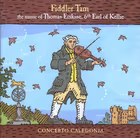
Thomas Erskine, 6th Earl of Kellie: Fiddler Tam, Concerto Caledonia
- Composer
- Thomas Erskine, 6th Earl of Kellie
- Artist
- Concerto Caledonia
- Label
- Linn Records
- Catalogue
- CKD 240
- Reviewed by
- Anne McAlister
Wine, women and song: such were the pleasures of life for Thomas Erskine, 6th Earl of Kellie. It would appear that he devoted his life wholeheartedly to all three; indeed, it was said of him that his nose was so red, it would ripen cucumbers. Not surprisingly, he died aged 49 of a “paralytic shock” followed by a “putrid fever”. However, Fiddler Tam (as he was dubbed on account of his skill on the violin) packed much into his relatively short life. Born in Kellie Castle, Fife, in 1732, he spent much of his early twenties in Mannheim studying composition and violin with Stamitz. On his return to Britain he was the first to exploit the new Mannheim style with its dramatic crescendos, and it is clear from his contemporaries’ correspondence that he was highly regarded as a composer. Much of his music has been lost; for a long time it was believed that a set of six overtures and six trio sonatas were the only compositions of substance to have survived, but some of his chamber music (including several string quartets) has since surfaced at Kilravock Castle. This is the first disc devoted entirely to Kellie’s music. It provides an excellent overview, ranging from symphonic-scale works for wind and strings to intimate trio sonatas, with an attractive short concert aria and song (sung by Mhairi Lawson) and a strathspey and reel (played by Cape Breton and baroque fiddler David Greenberg) thrown in. The Overture in C op.1 no. 2, really a small-scale symphony, boasts a rousing opening Allegro complete with Mannheim crescendo, a delicate Andantino second movement and lively concluding Presto Assai. The Overture in B flat, The Maid of the Mill, is in similar vein, with thrilling rhythmic energy and expressive use of oboes, horns and bassoon. Kellie clearly intended his Quartets to be played both as chamber and as orchestral music, so Concerto Caledonia give us a taste of each: the Quartet No. 8 is played as a “great Concert” with full strings and harpsichord, while No. 9 is played as a “small Concert” with string quartet. The latter work in particular is very fine, with a very catchy Allegro molto first movement, a sorrowful Adagio and a poised, elegant Minuet and Trio, complete with Scotch snaps. In the disc’s concluding Trio Sonata no. 6 in G a baroque flute substitutes for violin most effectively. I was astonished at the inventiveness and robust vitality of much of the music on this recording; the whole disc is an absolute delight, and will surely be enjoyed by anyone with even a remote interest in Scotland’s classical music heritage.
A note on this page
Originally published by Anne McAlister, recovered from mmmusic's own archive and reproduced here as the critic wrote it.
Questions about this recording
Who was Thomas Erskine, 6th Earl of Kellie?
A Scottish aristocrat and composer (1732–1781), nicknamed 'Fiddler Tam' for his skill on the violin, who studied composition and violin with Stamitz in Mannheim in his twenties and was among the first to bring the dramatic Mannheim style back to Britain.
Why is this recording significant?
It's the first disc devoted entirely to Kellie's music, drawing on works long believed lost until some of his chamber music, including several string quartets, surfaced at Kilravock Castle.
What's on the disc?
Symphonic-scale overtures, intimate trio sonatas, two string quartets played both as chamber and orchestral music, a concert aria and song sung by Mhairi Lawson, and a strathspey and reel played by fiddler David Greenberg.
Is this recording still available to buy?
Yes, Linn Records' catalogue number CKD 240 remains findable through classical retailers. We don't run an in-house shop, so we link out to Amazon and Discogs below.


