
CD Review
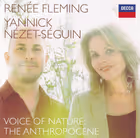
Various: Voice of Nature: The Anthropocene, Renée Fleming, soprano
- Composer
- Various
- Artist
- Renée Fleming, soprano; Yannick Nézet-Séguin, piano
- Label
- Decca
- Catalogue
- B0034565-02
Renée Fleming’s Voice of Nature: The Anthropocene, released on Decca in 2021, is a recital built around a single unifying idea rather than a survey of favourite repertoire: music that responds, directly or obliquely, to the natural world, and to the damage being done to it. Fleming is joined at the piano by Yannick Nézet-Séguin, the Metropolitan Opera’s music director, in an accompanist’s role rather than a conductor’s — a different kind of collaboration from the orchestral work most listeners associate him with. The album went on to win the 2023 Grammy Award for Best Classical Solo Vocal Album, Fleming’s fifth Grammy from eighteen career nominations.
About the programme
The recital moves between two poles: repertoire from the 19th- and early-20th-century art-song tradition that already engages with landscape and the natural world, and new commissions written specifically for this project by Nico Muhly, Caroline Shaw and Kevin Puts. Rather than treating the older and newer material as separate halves of the disc, the sequencing interleaves them, letting a listener hear how a contemporary composer’s response to environmental anxiety sits against a Romantic-era composer’s more traditional pastoral mode. Fleming has spoken about the album’s origins in the solace she found in hiking during the pandemic lockdown — a personal starting point that shaped a programme concerned less with nature as scenic backdrop than with its fragility in an era now widely termed the Anthropocene, after the scale of human impact on the planet’s systems.
About the performers
Renée Fleming is among the most recorded and most decorated American sopranos of her generation, with a career built across both opera and the recital repertoire; this was her fifth competitive Grammy win. Her choice to build an entire album around a specific environmental theme, rather than a composer or period, reflects an artist well into a career secure enough to take on a more essayistic kind of project. Yannick Nézet-Séguin, better known to most listeners as the Metropolitan Opera’s music director and the Philadelphia Orchestra’s, appears here purely as a collaborative pianist — a return, in effect, to the kind of chamber-scaled recital partnership that underpins much of the vocal repertoire on this disc, and a different register from his usual podium work.
Why a theme album
Art-song recitals have long drawn on nature imagery — it is one of the tradition’s oldest subjects, running from Schubert’s streams and winter journeys through to Mahler’s forest settings. What distinguishes Voice of Nature is its explicit contemporary framing: commissioning three living composers to write directly into the album’s environmental theme turns a familiar repertoire preoccupation into something closer to a considered artistic statement about the present moment, rather than a period convention being revisited. For a singer with Fleming’s history of career-spanning breadth — opera, crossover, art song, new commissions — the format lets several of those strands sit on one disc without any of them feeling like an afterthought.
Reception
The album’s Grammy win added to a career that already included five previous Grammy Award competitive wins as well as a Special Merit Award, and reviewers noted the unusual coherence of a themed recital held together by a specific idea rather than a composer or period — a format that risks feeling like a curatorial exercise rather than a genuine musical statement if the underlying material isn’t strong enough to support it. The presence of three newly commissioned works alongside older repertoire was widely read as evidence that Fleming intended the album as more than a retrospective victory lap, giving contemporary composers direct creative ownership of the project’s central theme rather than leaving it entirely to repertoire choices made after the fact.
A note on this page
This is new writing about a real, current recording, not part of the archive recovered from mmmusic’s original 1991–2018 run. It draws on independently verified facts about the recording, its performers and its reception, extending the same standard of factual reporting to work made well after the shop itself stopped trading.
Questions about this recording
What's the theme of this recital?
Voice of Nature: The Anthropocene is built entirely around music that responds to the natural world, from Romantic-era song through to new commissions written specifically for the project, framed around the fragility of the environment in the current geological era popularly called the Anthropocene.
Who wrote the new commissions on the album?
Nico Muhly, Caroline Shaw and Kevin Puts each contributed new works, sitting alongside repertoire drawn from the wider art-song tradition.
What prompted the project?
Fleming has said the album grew out of the solace she found hiking near her home during pandemic lockdown, which sharpened her sense of both the natural world's beauty and its vulnerability.
Did this album win a Grammy?
Yes — it won the 2023 Grammy Award for Best Classical Solo Vocal Album, Fleming's fifth Grammy win from eighteen nominations across her career.
Is this recording still available to buy?
Yes — Decca's release remains available through the label and classical retailers. We don't run an in-house shop, so we link out to Amazon and Discogs below.


