
CD Review
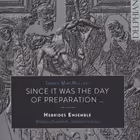
MacMillan: Since it was the Day of Preparation...
- Composer
- MacMillan
- Artist
- Hebrides Ensemble, Synergy Vocals, Brindley Sherratt (bass)
- Label
- Delphian
- Catalogue
- DCD34168
- Reviewed by
- Anne McAlister
This work received its world premiere performance in Greyfriars Kirk during the 2012 Edinburgh International Festival. It has bedded down (to much critical acclaim) over the course of several subsequent performances by a virtually unchanged cast. The arguably over-long original score has been judiciously pruned by the composer, although at 72 minutes it is still substantial.
The title Since it was the Day of Preparation… is the first line of text following the death of Christ in St John’s Gospel. The work is in three parts, punctuated by cadenza-like solo ‘motets’ for the five instruments (theorbo, cello, clarinet, harp and horn). A solo bass voice takes the role of Christ. The narrative encompasses events from the piercing of Christ’s body on the cross to the appearance of Christ on the shore after his Resurrection. Each virtuosic instrumental solo, three or four minutes long, gives space for reflection, as well as being arresting in both its writing and its delivery.
Although the first part of the work starts off relatively conventionally, with tenor then baritone delivering the narration, the instrumental quintet at the end of Part 1, prayerful initially, transforms into a spirited Middle-Eastern sounding dance. Part Two sees a complete change of mood, the narrative shared among various combinations of singers, the writing often angular, with instrumental accompaniment ranging from lyrical to punchy. The moment where the clarinet’s solo segues into a tranquil four-part motet is especially moving.
The drama is effectively sustained through the third part, the baritone’s solo narrative contributions exceptionally fine, the vocal interjections and colourful instrumental writing heightening the atmosphere. The interpolation of the Tu es Petrus and Salve festa dies texts and hints of Renaissance-style polyphony towards the conclusion adds to the sense of history and climax, as does the viscerally thrilling horn solo.
This recording was made in Glasgow’s RSNO Centre in 2015, the acoustic pleasingly generous. It speaks volumes for the skill of Sir James MacMillan that he has produced a work that is instantly compelling, approachable and yet innovative in so many ways, and that from a text that at first glance does not appear to offer rewarding dramatic opportunities.
A note on this page
Originally published by Anne McAlister, recovered from mmmusic's own archive and reproduced here as the critic wrote it.
Questions about this recording
What is the work's title taken from?
It's the first line of text following the death of Christ in St John's Gospel, and the piece narrates events from the piercing of Christ's body on the cross through to his appearance on the shore after the Resurrection.
Where and when was it premiered?
At Greyfriars Kirk during the 2012 Edinburgh International Festival, with largely the same performers heard on this recording, made in Glasgow's RSNO Centre in 2015.
How is the work structured?
In three parts, punctuated by cadenza-like solo 'motets' for five instruments, theorbo, cello, clarinet, harp and horn, with a solo bass voice taking the role of Christ.
Is this recording still available to buy?
Yes, Delphian's catalogue number DCD34168 remains findable through the label and classical retailers. We don't run an in-house shop, so we link out to Amazon and Discogs below.


