
CD Review
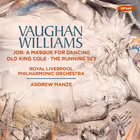
Ralph Vaughan Williams: Job: A Masque for Dancing
- Composer
- Ralph Vaughan Williams
- Artist
- Royal Liverpool Philharmonic Orchestra / Andrew Manze
- Label
- Onyx Classics
- Catalogue
- ONYX4240
Andrew Manze’s recording of Ralph Vaughan Williams’s Job: A Masque for Dancing with the Royal Liverpool Philharmonic Orchestra, released on Onyx Classics in 2023, won the Orchestral Award at the 2024 Gramophone Classical Music Awards, recognition for a large-scale, relatively under-programmed work by one of the central figures of twentieth-century English orchestral music.
Vaughan Williams completed Job in 1930, working not from the biblical Book of Job directly but from William Blake’s series of illustrations for it, a deliberate step removed from the source text that shapes how the ballet’s eight scenes are structured, following the visual and narrative logic of Blake’s images of Job’s suffering, his confrontation with Satan, and his eventual restoration, rather than a literal narration of the biblical story. The score runs to around 45 minutes for full orchestra, making it one of Vaughan Williams’s largest orchestral statements outside his nine numbered symphonies, and its combination of pastoral English lyricism with harmonically astringent, sometimes violent writing for the Satan-related scenes gives it a wider expressive range than the “gentle English pastoralist” reputation the composer is sometimes reduced to.
A ballet score, not a concert-hall regular
Because Job was written specifically for staged ballet performance rather than as a standalone concert piece, it’s programmed by orchestras considerably less often than Vaughan Williams’s symphonies, which occupy an established place in the standard orchestral repertoire worldwide. That relative rarity in live performance is part of what makes a strong studio recording valuable: for most listeners, a recording is the realistic way to encounter the piece at all, rather than one option among several live performances in a given concert season.
The rest of the disc
The recording pairs Job with two shorter, related works: Old King Cole, another ballet score for orchestra, and The Running Set, a concert work built directly on traditional English country-dance tunes. Programming all three together gives the disc a coherent focus on Vaughan Williams’s orchestral writing connected to dance and traditional English melody, rather than pairing the major work with unrelated repertoire simply to fill out the running time, a curatorial choice that makes the disc a genuinely useful single-disc survey of this specific strand of the composer’s output.
About the performers
Andrew Manze’s own career took an unusual route into this repertoire. He began as a specialist Baroque violinist, working with Ton Koopman’s Amsterdam Baroque Orchestra before becoming associate director of the Academy of Ancient Music in 1996 and artistic director of The English Concert from 2003 to 2007, building his early reputation entirely within the period-instrument early-music world. From the mid-2000s he moved into conducting modern-instrument orchestras, including tenures with Germany’s NDR Radiophilharmonie and Sweden’s Helsingborg Symphony Orchestra, alongside his work with British orchestras including the Royal Liverpool Philharmonic. That grounding in historically informed performance carries over into how he approaches even mainstream Romantic and twentieth-century English repertoire like this recording, with an attentiveness to texture and rhythmic character that a conductor coming purely from the modern-orchestra tradition might not bring to the same score.
The Royal Liverpool Philharmonic Orchestra is itself one of the UK’s longest-established symphony orchestras, with a long history of championing British repertoire specifically. That combination, a conductor with an unusually direct route into this specific English orchestral tradition, and an orchestra with deep roots in it, is a meaningful part of why this recording carries the authority it does within Vaughan Williams’s discography.
A note on this page
This is a freshly written review of a real, award-winning recording, not a page recovered from mmmusic’s archive of reviews from its original 1991–2018 run. We’re covering it as part of extending the same kind of grounded, fact-checked coverage to significant current releases in English orchestral repertoire.
Questions about this recording
What is Job: A Masque for Dancing?
A large-scale ballet score by Ralph Vaughan Williams, completed in 1930, based on William Blake's illustrations for the biblical Book of Job rather than the biblical text directly. It's scored for full orchestra and runs to around 45 minutes, making it one of Vaughan Williams's biggest orchestral works outside his numbered symphonies.
Why is Job less well known than Vaughan Williams's symphonies?
As a ballet score written for a specific staged production, it's programmed by concert orchestras less often than the symphonies, which have an established place in the standard concert repertoire. It's still widely admired among specialists in the composer's output, but reaches general listeners less frequently.
What else is on this disc?
Old King Cole, a shorter ballet score for orchestra, and The Running Set, a concert work built on traditional English dance tunes, giving the disc a coherent theme of Vaughan Williams's dance-related orchestral writing rather than pairing Job with unrelated repertoire.
What did this recording win?
The Orchestral Award at the 2024 Gramophone Classical Music Awards.


