CD Review
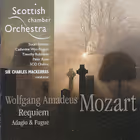
Mozart: Requiem · Adagio & Fugue, Susan Gritton
- Composer
- Mozart
- Artist
- Susan Gritton; Scottish Chamber Orchestra & Chorus / Mackerras
- Label
- Linn
- Catalogue
- CKD 211
- Reviewed by
- Sandy Matheson
Mozart’s unfinished Requiem presents the performer with considerable practical problems. Although the completion by Mozart’s pupil Franz Xaver Süssmayr contains many infelicities of grammar, structure and orchestration, it was the basis for almost all performances of the work for nearly two centuries. In recent years, several notable attempts to improve on Süssmayr’s efforts have been published. Sir Charles Mackerras, in his new recording with the Scottish Chamber Orchestra, has opted for Robert Levin’s edition, which seeks to “revise not as much, but as little as possible”. It is a triumph of creative musicology, and deserves to become the standard text for the work.
Sir Charles catches the desperate nature of the inspiration in much of the Introitus (the part more or less finished by Mozart). The strings’ lacerating attack at the start of the Confutatis is typical of his approach. He is helped by incisive, punchy singing from the SCO Chorus, well captured in a clear recording with deep perspectives. The solo quartet, led by Susan Gritton, adds up to rather more than the sum of its parts; their fervent contributions in the Recordare are particularly affecting.
Sir Charles has chosen to couple the Requiem with the severe Adagio and Fugue in C minor, a relatively early product of Mozart’s interest in the music of J.S. Bach. It is delivered with robust authority by the SCO strings.
About the Requiem’s origins
The commission behind Mozart’s Requiem was famously shrouded in mystery even at the time. In July 1791, a well-dressed stranger delivered Mozart an unsigned commission for a Requiem Mass along with a demand for strict secrecy about who it was for, the patron was later identified as Count Franz von Walsegg, an amateur musician with a habit of commissioning works and passing them off as his own, who wanted a memorial for his young wife, who had died that year. Mozart died on 5 December 1791, one day after completing the first four bars of the Lacrimosa, leaving the rest to be finished by his pupils, which is exactly the practical problem, and the reason later editions like Levin’s exist at all, that the review above opens by describing.
A note on this page
Originally published by Sandy Matheson, recovered from mmmusic's own archive and reproduced here as the critic wrote it.
Questions about this recording
Whose completion of Mozart's Requiem does this recording use?
Robert Levin's edition, which the review notes seeks to 'revise not as much, but as little as possible' compared with Mozart's pupil Franz Xaver Süssmayr's original completion, the basis for almost all performances for nearly two centuries.
What is the Requiem paired with on this disc?
Mozart's Adagio and Fugue in C minor, K546, an earlier work reflecting his interest in the music of J.S. Bach, delivered by the SCO strings.
Who leads the solo quartet on this recording?
Susan Gritton, whose contributions the review singles out in the Recordare as particularly affecting, leading a quartet that adds up to more than the sum of its parts.
Is this recording still available to buy?
Yes, Linn's catalogue number CKD 211 remains findable through classical retailers. We don't run an in-house shop, so we link out to Amazon and Discogs below.


