CD Review
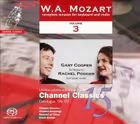
Mozart: Complete Sonatas for Keyboard and Violin, Volume 3
- Composer
- Mozart
- Artist
- Rachel Podger, violin; Gary Cooper, fortepiano
- Label
- Channel Classics
- Catalogue
- CCS CAT 20067
- Reviewed by
- Anne McAlister
In the not-so-distant past, the merest mention of the word “fortepiano” was sufficient to scare off all but diehard “early keyboard” enthusiasts. I admit to being one of the more sceptical; however, a couple of concerts at Edinburgh’s St Cecilia’s Hall have recently led me to revise my views. With the right instrument, in sympathetic hands, the use of a fortepiano can most certainly enhance rather than detract from the merits of a recording, as is perfectly illustrated by Channel Classics’ cycle of Mozart sonatas for keyboard and violin, which has now reached volume three.
Mozart’s sonatas are really duos for keyboard and violin; the instruments are equal partners in the later sonatas, while the earlier works are for keyboard with optional violin part. Gary Cooper plays a warm-toned copy of a Viennese fortepiano of 1795, which is an ideal foil for Rachel Podger’s mellow-sounding 1739 Pesarinius violin. As in the first two volumes in the series, this disc contains a mixture of earlier and later sonatas.
The meat of the disc lies in the opening and closing works, dating from Mozart’s time in Vienna. The lyrical opening Largo of the Sonata in B flat K454 gives way to the verve and dash of an Allegro, where each performer is able to play with a robust attack without fear of drowning the other. The penetrating and imaginative Andante gives Podger the chance to display a wonderful depth of tone, while in the final Allegretto movement dazzling passages which might sound superficial on more modern instruments here sound gutsy and impressive. The Sonata in E flat K380 is full of musical ideas, particularly in the sublime slow movement, and just listen to track 15 at 2’10” for the most beautiful pearlescent sounds from the fortepiano.
It has to be said that Mozart’s Sonata in B flat K8, composed when he was 8, does not display the airiness and grace of his later works, and the optional violin part is very much second fiddle to the keyboard; the Sonata in C K28, composed when he was 10, is a markedly better work, with some wonderfully florid writing for the keyboard. The disc is rounded out with two miscellaneous works of which the booklet makes no mention other than in the track listing.
Throughout, the playing of Cooper and Podger is superb, effortlessly virtuosic where required, ever alert to the musical possibilities of the works be they early or later Mozart, and always interesting. The first two volumes in this series are full-price; this version is currently at low mid-price as it comes packaged with a Channel Classics catalogue, presumably to tempt you in the direction of further purchases. Snap up this bargain soon before the offer is discontinued!
A note on this page
Originally published by Anne McAlister, recovered from mmmusic's own archive and reproduced here as the critic wrote it.
Questions about this recording
What's on this recording?
The third volume of Rachel Podger and Gary Cooper's Channel Classics cycle of Mozart's sonatas for keyboard and violin, including the Sonata in B flat K8, the Sonata in E flat K380, and the Sonata in B flat K454, among others.
What instruments are used?
Gary Cooper plays a copy of a 1795 Viennese fortepiano, and Rachel Podger plays a 1739 Pesarinius violin, a period-instrument approach rather than modern piano and violin.
Are Mozart's violin sonatas equal duets, or is one instrument dominant?
It varies by period: the earlier sonatas on this disc are written for keyboard with an optional violin part, while the later Vienna-period sonatas treat both instruments as genuinely equal partners.
Is this recording still available to buy?
Yes, Channel Classics' catalogue number CCS CAT 20067 remains findable through the label and classical retailers. We don't run an in-house shop, so we link out to Amazon and Discogs below.


