CD Review
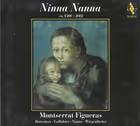
Traditional / Arvo Pärt and others: Ninna Nanna, Lullabies
- Composer
- Traditional / Arvo Pärt and others
- Artist
- Montserrat Figueras, soprano; Jordi Savall, Andrew Lawrence-King, Paul Badura-Skoda and others
- Label
- Alia Vox
- Catalogue
- AV 9826
- Reviewed by
- Anne McAlister
Soprano Montserrat Figueras has made her name almost entirely in the early-music field, focussing on Hispanic baroque and traditional music. In this fascinating disc of lullabies from many traditions and eras, she extends her repertoire to include songs from the 19th and 20th centuries, plus two lullabies composed for this album in 2002 by Estonian composer Arvo Pärt. The traditional songs hail mainly from the Mediterranean countries, Greece, Portugal, Spain, North Africa and Israel, and are performed most effectively and atmospherically, accompanied by instruments ranging from psaltery, bells and recorder to guitar and viol. Two English lullabies are featured. The simple song, My little sweet darling, in a hypnotic triple time, dates from 1580 and benefits from Figueras’s slightly ethnic performance style. However, William Byrd’s serene Come, pretty babe does not fare so well, quaint pronunciation and typically Spanish vocal inflections leave one longing for a purer-toned classical performance, and I felt similarly about the Reichardt song (in French) based on a Scottish lullaby. However, the remaining songs are fascinating, cradle songs by Reger, Milhaud and Mussorgsky accompanied on piano, folk songs by Falla and Lorca with romantic guitar, and the two Arvo Pärt lullabies. Pärt captures perfectly the melancholy and sweetness of typical folk lullabies in his Russian Christmas lullaby, a setting of a verse from the Gospel according to St Luke. In Pärt’s folky Estonian lullaby Figueras is joined by her daughter, Arianna Savall, in a very simple but effective duet whose only words are Kuus, kuus kallike, the Estonian equivalent of Lully, lullay. Mother and daughter also feature together in what for me is the highlight of the disc, the Catalan lullaby Mareta, Mareta, an exquisite duet accompanied by baroque flute, guitar, viola and bells. I have to admit that I’ve become hooked on this disc, despite my reservations about the Byrd and the rather excessive sense of melancholy engendered by the mournful Italian canzonetta which follows it. Soothing, interesting and imaginatively compiled and performed, Ninna Nanna deserves a wide audience.
A note on this page
Originally published by Anne McAlister, recovered from mmmusic's own archive and reproduced here as the critic wrote it.
Questions about this recording
What's the range of material on this disc?
Lullabies spanning roughly five centuries, traditional cradle songs from the Mediterranean, the Balkans and Israel, English lullabies from the 16th century, art-song settings by Reger, Milhaud and Mussorgsky, folk songs by Falla and Lorca, and two newly composed lullabies written for this album in 2002 by Arvo Pärt.
Who else performs on the disc besides Montserrat Figueras?
A range of period-instrument specialists including Jordi Savall, Andrew Lawrence-King and Paul Badura-Skoda, plus Figueras's own daughter Arianna Savall, who joins her for a duet on Pärt's Estonian lullaby.
What language is the Estonian lullaby sung in?
Estonian, its text is just the words "Kuus, kuus kallike," the Estonian equivalent of the English lullaby refrain "Lully, lullay."
Is this recording still available to buy?
Yes, Alia Vox's catalogue number AV 9826 remains findable through classical retailers. We don't run an in-house shop, so we link out to Amazon and Discogs below.


