CD Review
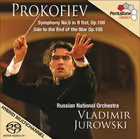
Prokofiev: Symphony No. 5
- Composer
- Prokofiev
- Artist
- Russian National Orchestra / Vladimir Jurowski
- Label
- PentaTone
- Catalogue
- PTC 5186 083
- Reviewed by
- Anne McAlister
Vladimir Jurowski is one of today’s most exciting young conductors. He gained extensive opera experience in the early stages of his career and has conducted many of the world’s top orchestras. In September this year he became principal conductor of the LPO, and he has worked frequently with the Russian National Orchestra with whom he recorded this Prokofiev disc.
Pentatone’s recording sounds superb, which is an immediate plus point when comparing this performance with that of Gergiev and the LSO in their Gramophone award-winning survey of the complete Prokofiev symphonies. Decca’s engineers coped impressively with the difficulties presented by the Barbican, but compared to this new recording (made in the Grand Hall of the Moscow Conservatory) the Decca sound is too close-miked and slightly oppressive. The sound of the orchestras is also markedly different, the LSO’s blended tones contrasting with the edgy strings, burnished brass and characterful wind sound of the Russians.
Gergiev’s and Jurowski’s readings of the work are remarkably similar; Gergiev has perhaps the more cohesive view of the work, whereas Jurowski occasionally lingers, but this new recording is certainly full of drama. The symphony is written very much in the language of Romeo and Juliet (indeed, the opening of the Scherzo uses material left over from that work). The tension builds and subsides in the first movement, with deceptively innocent opening melodies changing radically into menacing militaristic themes and the percussion threatening to overwhelm at the end of the movement. Jurowski’s handling of the Scherzo sounds just a little more contrived than that of Gergiev, but the Adagio is full-blooded and dramatic. The final movement, built around a jolly Soviet galop, gives Jurowski ample scope to display the range of orchestral colour at his disposal.
The other work featured, Ode to the End of the War, is something of a rarity, hardly surprising, considering it is scored for the unlikely combination of 8 harps, 4 pianos, wind orchestra, percussion and 8 double basses. It’s a dark-hued work, with a heavy, oppressive first section giving way to much more lyrical music before harsher, more powerful themes take over and ultimately triumph. It’s certainly not empty bombast, and it’s good that we’ve been given the chance to hear it, again in splendid sound.
A note on this page
Originally published by Anne McAlister, recovered from mmmusic's own archive and reproduced here as the critic wrote it.
Questions about this recording
What's on this recording?
Prokofiev's Symphony No. 5, paired with the rarely-performed Ode to the End of the War, an unusual work scored for 8 harps, 4 pianos, wind orchestra, percussion and 8 double basses.
How does this compare to Gergiev's version with the LSO?
The review compares it directly against Gergiev's Gramophone award-winning LSO recording, Pentatone's sound (recorded in Moscow's Grand Hall of the Conservatory) is judged less close-miked and oppressive than Decca's Barbican-recorded sound, and the readings are broadly similar though Jurowski occasionally lingers where Gergiev is more cohesive.
Who is Vladimir Jurowski?
A conductor who became principal conductor of the London Philharmonic Orchestra in September 2007, the same year as this recording, with extensive earlier opera experience and a long working relationship with the Russian National Orchestra.
Is this recording still available to buy?
Yes, PentaTone's catalogue number PTC 5186 083 remains findable through the label and classical retailers. We don't run an in-house shop, so we link out to Amazon and Discogs below.


