
CD Review
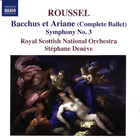
Roussel: Symphony No. 3 / Bacchus et Ariane
- Composer
- Roussel
- Artist
- Royal Scottish National Orchestra / Stéphane Denève
- Label
- Naxos
- Catalogue
- 8.570245
- Reviewed by
- Anne McAlister
The RSNO’s new music director Stéphane Denève has made no secret of his affinity with the music of his native land. Several concerts in the RSNO’s 2006/07 season included French works, among them Roussel’s Symphony No. 3. Albert Roussel studied with D’Indy and absorbed the Impressionist tendencies of such composers as Debussy and Ravel, but it is the influence of Stravinsky’s neo-classical music that comes across most clearly in this programme. The symphony is an immediately likeable work, driving rhythms alternating with expressively tranquil themes. The serene solo violin introduced towards the end of the second movement reappears in the last movement, enhancing the beauty of the music before the finale regains its momentum.
The two suites that make up the ballet Bacchus et Ariane date from the same period (1930) and are similar in style to the symphony. Bacchus’s ultimately successful wooing of Ariane gives the composer plenty scope for energetic dances, interludes of sensuous languor and moments of uninhibited Bacchanalian frenzy. The RSNO, obviously inspired by its conductor’s enthusiasm for the works, gives pulsating performances. If you have not yet sampled any of Roussel’s music, this is the disc to start with!
About the composer
Roussel’s route into music was unusually roundabout for a major French composer: he joined the navy at eighteen, and it was voyages to French Indo-China during his naval service, not conservatory training, that first gave him the exotic orchestral colouring later audible across his output. He didn’t resign his commission to study music seriously until 1894, in his mid-twenties, going on to study at the Schola Cantorum under Vincent d’Indy from 1898 and later teaching counterpoint there himself, with pupils including Erik Satie and Edgard Varèse. That late start, combined with a period of active service again in the First World War, means the neo-classical voice heard in this 1930 symphony belongs to a composer who arrived at his mature style relatively late, after two entirely different careers first.
A note on this page
Originally published by Anne McAlister, recovered from mmmusic's own archive and reproduced here as the critic wrote it.
Questions about this recording
What's on this disc?
Roussel's Symphony No. 3 paired with the two suites that make up his ballet Bacchus et Ariane, both dating from around 1930.
What influences shaped Roussel's Symphony No. 3?
Roussel studied with Vincent d'Indy and absorbed Impressionist tendencies from composers like Debussy and Ravel, but it's the influence of Stravinsky's neo-classical music that comes across most clearly in this symphony.
Why did the RSNO record this programme?
Music director Stéphane Denève made no secret of his affinity with French music from his native country, and several concerts in the RSNO's 2006/07 season included French works, Roussel's Symphony No. 3 among them.
Is this recording still available to buy?
Yes, Naxos's catalogue number 8.570245 remains findable through classical retailers. We don't run an in-house shop, so we link out to Amazon and Discogs below.


