
CD Review
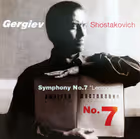
Shostakovich: Symphony No.7 "Leningrad", Kirov Orchestra
- Composer
- Shostakovich
- Artist
- Kirov Orchestra; Rotterdam Philharmonic Orchestra / Gergiev
- Label
- Philips
- Catalogue
- 470 8452
- Reviewed by
- Kate Grue
While the 7th Symphony is perhaps not as intellectually stimulating or satisfying as Shostakovich’s later symphonies such as the 11th and the 14th, nevertheless it is an electrifying work. Written in 1941 during the siege of Leningrad by the Nazis, the thematic material is infused with a sense of outrage, mixed with very dark humour, and desperate nationalism. This performance, conducted by the insomniac conductor Valery Gergiev, was recorded in 2001, but released this year as part of St Petersburg’s tercentenary celebrations.
Two great orchestras, the Kirov and the Rotterdam Philharmonic, are in stonking good form and the fact that this is a live recording does not detract from the quality of the sound. Gergiev marshals these forces with unfailing expertise; the tempi never drag and dialogue between different voices in the increasingly frenetic 2nd movement is suitably schizoid. Not for the fainthearted, the last movement can set your teeth fairly on edge with its relentless drive.
There are other versions of this symphony which have received good notices, namely the Chandos recording with the RSNO and Neeme Järvi (which has a little too much dynamic variation for my liking) and Bernstein’s 1988 live recording with the Chicago Symphony. But Gergiev’s reading is an important addition to the catalogue; this conductor’s contribution to Russian music-making is legendary already. Don’t buy the new recording with Semyon Bychkov and the Westdeutscher Rundfunk Köln; the orchestra is good, but the deeply unattractive conductor takes too long over the whole, and the music grinds to a halt.
About the symphony’s Leningrad premiere
No recording of this symphony can really be separated from the story of its first Leningrad performance, on 9 August 1942, still under siege. The city’s own Radio Orchestra had gone from 40 players to barely 15 through starvation and combat losses, nowhere near the 100-plus musicians the score demands, so surviving military musicians were pulled in to fill the gaps; three players reportedly collapsed and died during rehearsals. The score itself had to be flown and smuggled into the besieged city on microfilm. On the night, Soviet artillery deliberately targeted German positions beforehand to keep them quiet during the performance, which was then broadcast outward by loudspeaker toward the German lines, a genuine act of psychological warfare as much as a concert. Against that backdrop, any studio or even live modern recording, however well played, is inevitably answering a very different question than what the symphony originally meant to the people who first heard it.
A note on this page
Originally published by Kate Grue, recovered from mmmusic's own archive and reproduced here as the critic wrote it.
Questions about this recording
Why is this symphony nicknamed "Leningrad"?
Shostakovich wrote it in 1941 during the Nazi siege of Leningrad, and its thematic material is infused with outrage, dark humour and desperate nationalism reflecting that context.
Is this a studio or live recording?
It's a live recording, made in 2001 with the Kirov and Rotterdam Philharmonic under Valery Gergiev, released in 2003 as part of St Petersburg's tercentenary celebrations.
How does this compare to other recordings of the symphony?
The review singles out Neeme Järvi's Chandos recording with the RSNO and Bernstein's 1988 live Chicago Symphony account as other well-regarded versions, while cautioning against a newer Semyon Bychkov/WDR Cologne recording.
Is this recording still available to buy?
Yes, Philips's catalogue number 470 8452 remains findable through classical retailers. We don't run an in-house shop, so we link out to Amazon and Discogs below.


