
CD Review
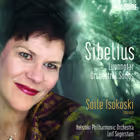
Sibelius: Luonnotar (Orchestral Songs), Soile Isokoski
- Composer
- Sibelius
- Artist
- Soile Isokoski; Helsinki Philharmonic Orchestra / Segerstam
- Label
- Ondine
- Catalogue
- ODE10805
- Reviewed by
- Sandy Matheson
There really isn’t anything quite like Luonnotar in the repertoire. Although it lasts less than ten minutes, its scale is massive, and its ideas and form are highly original. It was first performed at the Three Choirs Festival in 1913, sadly the reaction of the burghers of Gloucester is not recorded, but most likely it was one of baffled astonishment. The soloist on that occasion was the Finnish dramatic soprano Aino Ackté, the first Covent Garden Salome. I mention this because the vocal writing in Luonnotar appears to demand a Wagnerian-scaled voice, Sibelius employs a large orchestra, although he rarely requires his full forces.
Soile Isokoski is a Mozart/Strauss soprano (she’s sung Eva from Meistersinger, but I can’t see her venturing much further into Wagnerian repertoire). The success of her new recording of Luonnotar is in part due to Leif Segerstam’s finely-judged accompaniment. I’ve always been rather wary of Segerstam’s Sibelius on record. I’m hardly alone; his latest Sibelius cycle on Ondine was summed up in Gramophone as being “provocative, big-hearted and occasionally just bonkers!”. His conducting for Isokoski is right on the money; the purely orchestral climax (at around 5’30”) is mountainous, but whenever Isokoski is singing, he finds intense and rich colours within a generally piano dynamic that never overwhelm his soloist.
The rest of the CD includes a generous selection of orchestral songs, none of them on anything like the scale and significance of Luonnotar. These include “Did I just dream?”, a song made famous by Kirsten Flagstad. It’s perfectly suited to Isokoski’s warm, expressive voice; surely it’s only the language barrier (most of Sibelius’s songs are in Swedish) that discourages singers from taking them up. This CD complements Katarina Karnéus’s beautiful selection of Sibelius’s songs with piano accompaniment for Hyperion; both CDs are well worth collecting.
A note on this page
Originally published by Sandy Matheson, recovered from mmmusic's own archive and reproduced here as the critic wrote it.
Questions about this recording
What makes Luonnotar unusual in the orchestral repertoire?
Although it lasts less than ten minutes, its scale and formal ideas are highly original, Sibelius calls for Wagnerian-scaled vocal writing over a large orchestra he rarely uses at full force, an unusual combination with few real parallels.
Who gave the work's premiere?
It was first performed at the Three Choirs Festival in 1913, sung by the Finnish dramatic soprano Aino Ackté, who had created the title role in Covent Garden's first Salome.
What else is on this recording?
A generous selection of Sibelius's other orchestral songs, including "Did I just dream?", a song made famous by Kirsten Flagstad, most of Sibelius's songs are in Swedish, which the review suggests is why they're less often performed.
Is this recording still available to buy?
Yes, Ondine's catalogue number ODE10805 remains findable through classical retailers. We don't run an in-house shop, so we link out to Amazon and Discogs below.
What format was this Sibelius recording released in?
SACD rather than standard CD, Ondine catalogue ODE10805, Soile Isokoski's recording of Sibelius's orchestral songs, including Luonnotar, with the Helsinki Philharmonic under Leif Segerstam.

