CD Review
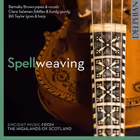
Traditional (Colin Campbell manuscript): Spellweaving, Ancient Music from the Highlands of Scotland
- Composer
- Traditional (Colin Campbell manuscript)
- Artist
- Barnaby Brown, Bill Taylor, Clare Salaman
- Label
- Delphian
- Catalogue
- DCD34171
- Reviewed by
- Anne McAlister
This disc presents the first fruits of a European Music Archaeology Project exploring our common European musical heritage by studying the music and sounds of the ancient past. Future discs will focus on other countries and traditions, but this recording starts close to home with music from the Highlands of Scotland.
Flautist and piper Barnaby Brown has been deciphering a remarkable document, Colin Campbell’s Instrumental Book 1797, which is the source of all the music on this disc. Campbell devised a unique notation through which he was able to record pibrochs which previously had been transmitted only orally. As Brown says, the quality of the music is seriously good. Placing it in the context of other research, and keen to reference a broader musical world, Brown and his fellow musicians Bill Taylor and Clare Salaman have asked the question: does this manuscript provide a window on to a musical culture beyond the piob mhór, or great pipe, of Highland culture?
The resulting arrangements of pibroch for Taylor’s lyre and clarsach, Salaman’s fiddles and hurdy-gurdy, and Brown’s Highland bagpipe and vulture bone flute provide a fascinating view of how music might have been evolving in Scotland before 1800.
I never expected to find myself interested in listening to pibroch, but this release has changed that! The related website is also well worth exploring.
The manuscript behind the music
The patronage of elite Highland pipers collapsed after the Jacobite rising of 1745, part of the wider dismantling of clan structures that followed Culloden. Worried that the classical music of the Gaels would fade away entirely, Edinburgh’s Highland Society offered prize money for a scientific notation that could preserve it in writing. By 1797, Colin Campbell had produced 377 pages in a unique notation of his own devising, based on the vocal mnemonics, vocables, traditionally used to teach pibroch by ear. Unintelligible to the judges who commissioned it, Campbell’s extraordinary act of preservation was set aside and largely misunderstood for the best part of two centuries before scholars like Barnaby Brown began seriously deciphering it.
About the project and performers
Spellweaving was recorded for Delphian Records, an independent Edinburgh-based classical label founded in 2003 and known for its work with historically informed performance and early music. The recording sits within the wider European Music Archaeology Project, an EU-supported research initiative bringing together archaeologists, instrument-makers and performers to reconstruct the sound worlds of Europe’s ancient and pre-modern past, this disc’s contribution being a reconstruction not of prehistoric instruments, but of a specific, rigorously documented moment in Highland musical history. Brown, Taylor and Salaman each work across historical performance more broadly: Brown as a piper and researcher into ancient reed instruments, Taylor as a specialist in early harps and lyres, and Salaman across historical string traditions, a combination that lets pibroch, usually heard on solo bagpipe alone, be heard instead as a wider Highland chamber-music tradition might once have sounded.
A note on this page
Originally published by Anne McAlister, recovered from mmmusic's own archive and reproduced here as the critic wrote it.
Questions about this recording
What is the source of the music on this recording?
Colin Campbell's Instrumental Book of 1797, a manuscript in which Campbell devised his own notation to write down pibrochs that had previously only been passed on orally.
What is pibroch?
Pibroch (from the Gaelic ceòl mòr, "great music") is the classical music tradition of the Highland bagpipe, extended sets of variations built on a theme, historically associated with elite piping families and played on formal or ceremonial occasions.
What instruments are used on the recording?
Barnaby Brown plays Highland bagpipe and a reconstructed vulture-bone flute, Bill Taylor plays lyre and clarsach (Scottish harp), and Clare Salaman plays fiddles and hurdy-gurdy, none of them the instrument pibroch is usually associated with today.
Is this recording still available to buy?
Yes, Delphian's catalogue number DCD34171 remains findable through the label and classical retailers. We don't run an in-house shop, so we link out to Amazon and Discogs below.


