CD Review
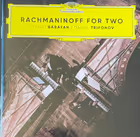
Sergei Rachmaninov: Rachmaninoff for Two
- Composer
- Sergei Rachmaninov
- Artist
- Daniil Trifonov, Sergei Babayan, pianos
- Label
- Deutsche Grammophon
- Catalogue
- 486 4805
Rachmaninoff for Two, released on Deutsche Grammophon in March 2024 and awarded a Diapason d’Or that November, pairs Daniil Trifonov, one of the most prominent concert pianists of his generation, with Sergei Babayan, his own former teacher, for a two-disc programme of Rachmaninov’s music for two pianos. It’s a different kind of recital from the concerto-and-orchestra format most listeners associate with a major soloist: no orchestra, no single star billing, just two pianists trading and combining lines across some of Rachmaninov’s most substantial writing for the combination.
About the programme
The recording centres on Rachmaninov’s two numbered Suites for two pianos, the earlier Op. 5 “Fantaisie-Tableaux” and the later, more contrapuntally developed Op. 17, alongside the two-piano version of the Symphonic Dances, Op. 45, Rachmaninov’s own last major orchestral work, which he arranged for two pianos himself before completing the orchestral score. The set also includes an excerpt from the Symphony No. 2 in a two-piano arrangement. Recording two-piano Rachmaninov at this scale is a genuine statement in itself, the Symphonic Dances in particular is more often heard in its orchestral form, and returning to the composer’s own two-piano version foregrounds the piece’s structural bones in a way the orchestral colour can sometimes obscure. Rachmaninov himself was closely tied to the two-piano medium as a performer as well as a composer: he and Vladimir Horowitz famously played through the two-piano version of the Symphonic Dances together privately in 1940, before its orchestral premiere, and Rachmaninov performed his own two-piano suites publicly across his career, giving the format on this disc a direct line back to how the composer himself experienced some of this music. The Symphonic Dances turned out to be Rachmaninov’s last major composition and the only large-scale work he wrote entirely after settling in the United States; he reportedly described it afterward as his “last spark,” and the piece is threaded with quotations from his own earlier music alongside Orthodox chant material, making it as much a retrospective summing-up of his career as a new statement.
About the performers
Sergei Babayan has taught at the Cleveland Institute of Music since 1992, where Daniil Trifonov became his student in 2009, a period, running through Trifonov’s Artist Certificate in 2013 and Artist Diploma in 2015, that overlapped with Trifonov winning first prizes at both the Arthur Rubinstein International Piano Master Competition and the Tchaikovsky Competition in 2011. The two have performed and recorded together as a duo on several previous occasions, including an earlier Deutsche Grammophon disc of transcriptions; this Rachmaninov recording is a return to that partnership on a larger scale, built around a single composer rather than a mixed programme.
A note on this page
This review is freshly written to cover a real, current recording, rather than recovered from mmmusic’s original 1991–2018 archive, the shop had closed years before this disc existed. It’s part of the site’s coverage of new classical releases, written from independently verified facts about the recording, its performers and its award, alongside the material recovered from the original site’s run.
Questions about this recording
What did this recording win?
A Diapason d'Or, awarded by the French classical music magazine Diapason, in November 2024.
What's on the two discs?
Rachmaninov's two Suites for two pianos (Op. 5 and Op. 17), the two-piano version of his Symphonic Dances, Op. 45, and an excerpt from his Symphony No. 2 in a two-piano arrangement.
How are Trifonov and Babayan actually connected?
Babayan was Trifonov's teacher at the Cleveland Institute of Music, where Trifonov studied with him from 2009, earning an Artist Certificate in 2013 and an Artist Diploma in 2015, the same period in which Trifonov won prizes at both the Rubinstein and Tchaikovsky competitions.
Is this recording still available to buy?
Yes, Deutsche Grammophon's catalogue number 486 4805 remains widely available through the label and classical retailers. We don't run an in-house shop, so we link out to Amazon and Discogs below.


