CD Review
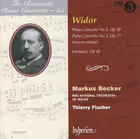
Widor: Piano Concertos 1 & 2 · Fantaisie, Markus Becker, piano
- Composer
- Widor
- Artist
- Markus Becker, piano; BBC National Orchestra of Wales / Thierry Fischer
- Label
- Hyperion
- Catalogue
- CDA67817
- Reviewed by
- Anne McAlister
Those of you who know composer Charles-Marie Widor only through his organ Toccata will have a real surprise with this disc! Widor was organist at Saint-Sulpice for over sixty years, and his organ symphonies drew the attention of connoisseurs. However, it was a ballet, La Korrigane, that first brought him to the attention of the general public in 1881, and his output includes songs, operas, chamber and symphonic works. As virtually none of this music is played today, it was intriguing to discover that Hyperion had recorded Widor’s two piano concertos and the Fantaisie. They span thirty years, the first concerto being written in 1876 when Widor was in his early thirties, and it is difficult to understand why they have lain neglected for so many years.
The Piano Concerto No. 1 in F minor is a substantial work, nearly thirty minutes long and contemporary with Tchaikovsky’s Concerto No. 1 and Saint-Saëns’s Concerto No. 4. It is very attractive, with a first movement developed from sonorous opening chords and a Schumannesque second theme. The slow movement is beautiful and serene, possibly influenced by Schumann and Liszt, while the slightly cheeky, bucolic theme of the scherzo-like third movement is very far from French froth.
Widor’s obvious talents for orchestration are further displayed in his Fantaisie in A flat major; this genre would soon become something of a French speciality, but Widor was among the first to try his hand at it, in 1888. He is amazingly inventive with somewhat limited material; the Times reviewer of the first performance described it as “something more than merely a brilliant and effective piece, since, like all M. Widor’s compositions, it has earnestness of purpose, great originality and no small amount of melodic beauty”.
The Piano Concerto No. 2 in C minor dates from 1905 and is a much darker, more impassioned work, quite different from its predecessor. Its stirring and impetuous first movement is followed by a relatively short and expressive Andante. This leads to a Tempo deciso final movement, a sequence of lively passages culminating in a return of the concerto’s main theme.
Thierry Fischer directs Markus Becker and the BBC National Orchestra of Wales in performances full of zest and vitality. This disc throws a whole new light on Widor, and I highly recommend it.
A note on this page
Originally published by Anne McAlister, recovered from mmmusic's own archive and reproduced here as the critic wrote it.
Questions about this recording
Why is Widor known mostly for his organ music?
He was organist at Saint-Sulpice in Paris for over sixty years, and his organ symphonies drew the attention of connoisseurs, but his wider output, including songs, operas, chamber and symphonic works, is virtually unplayed today.
How far apart were the two piano concertos written?
They span thirty years, the Piano Concerto No. 1 in F minor dates from 1876, when Widor was in his early thirties, while the darker, more impassioned No. 2 in C minor was written in 1905.
What else is on the disc?
Widor's Fantaisie in A flat major (1888) for piano and orchestra, an early example of a genre, the piano-and-orchestra fantaisie, that would become something of a French speciality.
Is this recording still available to buy?
Yes, Hyperion's catalogue number CDA67817 remains findable through the label and classical retailers. We don't run an in-house shop, so we link out to Amazon and Discogs below.


