
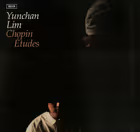
CD Review
Frédéric Chopin: Études, Op. 10 & Op. 25, Yunchan Lim, piano
- Composer
- Frédéric Chopin
- Artist
- Yunchan Lim, piano
- Label
- Decca
- Catalogue
- 487 0123
Yunchan Lim’s studio recording debut for Decca, released in 2024, pairs both complete sets of Chopin’s concert études, the twelve of Op. 10 and the twelve of Op. 25, and won the Gramophone Piano Award along with Gramophone’s Young Artist of the Year award the same year. Lim became the youngest-ever gold medallist at the Van Cliburn International Piano Competition in 2022, at eighteen, and this disc is his first full studio recording since that win, a significant debut given how closely a young competition winner’s first commercial release tends to be scrutinised against the performance that made their name.
Chopin’s études occupy a specific place in the piano repertoire: each of the twenty-four pieces is built around a particular technical demand, rapid octaves, close-interval thirds and sixths, independent voicing between hands that must otherwise move in tandem, wide arpeggiated figuration, while still working as a fully realised concert piece rather than a dry technical exercise, which is precisely what distinguishes Chopin’s études from the more mechanical studies that came before them. Recording the complete set, rather than a selection of the more famous individual études (the “Revolutionary,” the “Winter Wind,” the “Black Keys”), means confronting the full range of technical and expressive problems Chopin built into the form, back to back, without being able to sequence around any particular weakness.
About Yunchan Lim
Lim’s 2022 Van Cliburn win drew significant attention partly because of his age, eighteen at the time, the youngest gold medallist in the competition’s history, and partly because of the specific performance that clinched it, a Rachmaninov Third Piano Concerto widely discussed afterward for its combination of technical control and interpretive maturity unusual in a performer that young. A studio debut recording under that level of attention carries real expectations, and choosing the complete Chopin études rather than a mixed recital programme is a fairly direct way of putting his technique on record without any curatorial softening.
About the recording
Recording both complete sets together, rather than pairing a partial selection with other repertoire, is a comparatively unusual choice for a young pianist’s studio debut, it commits the entire disc to one composer’s most technically exposed single-instrument form, with nowhere for a technical or interpretive gap to hide across two dozen consecutive short pieces.
About the two sets
The Op. 10 études, published in 1833 and dedicated to Liszt, and the Op. 25 set that followed in 1837, were both written while Chopin was still in his twenties, and together they effectively established the concert étude as a serious form in its own right rather than a purely pedagogical exercise, a shift Liszt’s own later études for piano would extend further. Several individual pieces from the two sets have since acquired popular nicknames not given by Chopin himself, the “Revolutionary” (Op. 10 No. 12, associated, likely apocryphally, with the fall of Warsaw in 1831), the “Black Keys” (Op. 10 No. 5, played almost entirely on the piano’s black keys in the right hand), and the “Winter Wind” (Op. 25 No. 11) among them, nicknames that have become so entrenched in concert programming that they now appear on most commercial releases of the music, including this one.
A note on this page
This review was written fresh for mmmusic, covering a real, current recording. It isn’t part of the site’s recovered 1991–2018 archive, since the shop had already closed by the time this disc was released. We’ve written it from verified facts about the recording, the performer, and the award it won, extending the kind of coverage the original site gave to notable classical releases to what’s actually being recorded and recognised today.
Questions about this recording
Who is Yunchan Lim?
A South Korean pianist who, in 2022 at age 18, became the youngest-ever gold medallist at the Van Cliburn International Piano Competition. This Decca disc is his studio recording debut.
What's on the recording?
Both complete sets of Chopin's concert études, the twelve of Op. 10 and the twelve of Op. 25, twenty-four pieces covering the full range of the composer's technical and expressive demands for the form.
What did it win?
The 2024 Gramophone Piano Award, and Gramophone's Young Artist of the Year award in the same year.
Why are Chopin's Études considered especially demanding?
Each one is built around a specific technical problem, octaves, thirds, rapid arpeggios, independent voicing between the hands, while still functioning as a fully expressive concert piece rather than a dry exercise, a combination that makes the complete set a standard test of a pianist's all-round technique.


