CD Review
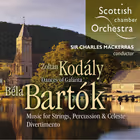
Bartók: Music for Strings, Percussion & Celesta
- Composer
- Bartók
- Artist
- Scottish Chamber Orchestra / Mackerras
- Label
- Linn Records
- Catalogue
- CKD 234
- Reviewed by
- Sandy Matheson
Bartók’s pair of masterpieces written for Paul Sacher’s Basle Chamber Orchestra makes an obvious coupling on record. Sir Charles Mackerras’s new version with the SCO comes hard on the heels of Nikolaus Harnoncourt’s fine recording with the Chamber Orchestra of Europe. The contrast of approach between the two is particularly evident in the Divertimento. I’ve often noticed that while foreign, especially American, performers tend to emphasise the strikingly powerful, chunky rhythms to be found in Bartók, Hungarian performers tend to treat the rhythms with a lighter touch, bringing out the lyricism in the music; compare, say, the approaches of the Hungarian and Juilliard Quartets to the string quartets and you’ll soon see what I mean. Sir Charles’s approach is close to the native Hungarian examples; for instance, that of János Rolla and the Franz Liszt Chamber Orchestra on Hungaroton. Harnoncourt, perhaps surprisingly given his mid-European roots, is much more angular, ‘modern’ if you like.
At a tempo several notches below Bartók’s prescribed quaver=88 Sir Charles achieves an extraordinary atmosphere in the work’s molto sostenuto second movement, especially in the rustling ‘nature music’ at the return of the principal theme (at Bar 56). It’s a fine account of one of Bartók’s most genial inspirations, although in the wide open spaces of the Usher Hall it is not always possible to hear the contrast between the concertino and ripieno passages with ideal clarity.
In a recent interview, Harnoncourt observed that the Music for Strings, Percussion and Celeste is “…more difficult than Le Sacre” adding that Ferenc Fricsay demanded 25 rehearsals for it, insisting that the work couldn’t be done with less. Neither of the new recordings avoids a sense of strain in this fiendishly hard piece; perhaps after all it is better, safer anyway, to do it with a slightly larger body of strings.
Unlike Harnoncourt, Sir Charles includes a bonus, and a substantial one, in the shape of Kodály’s lovely Dances of Galánta. It’s a fine showcase for the SCO’s excellent principal clarinet, Maximiliano Martin, who shapes the memorable rondo theme exquisitely. The Kodály was recorded in Greyfriars Kirk, and is I think the best recording I’ve heard from that venue.
A note on this page
Originally published by Sandy Matheson, recovered from mmmusic's own archive and reproduced here as the critic wrote it.
Questions about this recording
What's on this recording?
Bartók's Music for Strings, Percussion & Celesta and his Divertimento, paired with Kodály's Dances of Galánta, performed by the Scottish Chamber Orchestra under Sir Charles Mackerras.
How does this compare to Harnoncourt's recording of the same Bartók works?
The review contrasts Mackerras's approach, closer to native Hungarian performance traditions, emphasising lyricism, with Nikolaus Harnoncourt's more angular, 'modern' recording with the Chamber Orchestra of Europe.
Where was this recorded?
In Edinburgh, the Bartók works in the Usher Hall, and the Kodály in Greyfriars Kirk, described in the review as the best recording the reviewer had heard from that venue.
Is this recording still available to buy?
Yes, Linn's catalogue number CKD 234 remains findable through classical retailers. We don't run an in-house shop, so we link out to Amazon and Discogs below.


