CD Review
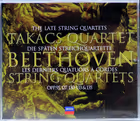
Beethoven: Late String Quartets, Takács Quartet
- Composer
- Beethoven
- Artist
- Takács Quartet
- Label
- Decca
- Catalogue
- 470 849-2
- Reviewed by
- Sandy Matheson
We don’t award stars to CDs in this publication; if we did, the Takács Quartet’s Beethoven cycle would get a heavenload of them. The final group of five quartets constitutes the apogée of quartet writing, and will always be the most daunting challenge for performers. (The present volume also includes a superb performance of the F minor quartet, Op. 95, room for which could not be found on their set of the middle period quartets.) In the first two volumes in the Takács survey, these marvellous players proved themselves equal to Beethoven’s fearsome technical demands, while demonstrating a deep understanding of what makes each work unique.
In the accompanying booklet, Edward Dusinberre, the quartet’s first violin, writes about relishing “the sharp contrasts of mood and extraordinary range of emotion conveyed in this music.” This does not exclude humour, even in the Grosse Fuge, beam in at 7’14” for a sparkily articulated Allegro molto con brio. The whole fugue, rightly placed within the Op. 130 quartet, with Beethoven’s light-weight alternative offered as an appendix, is the tour de force that it should be. Earlier in the same quartet the Takács deliver playing of the utmost concentration in the Cavatina.
Throughout the set the Takács sound is refined and luminous without any unwanted plushness, and Andrew Keener’s production offers sound of biting immediacy with just enough of the building (St. George’s, Bristol). This is likely to remain my principal recommendation for the Beethoven quartets for the foreseeable future.
About the quartet
The Takács Quartet was founded in 1975 at Budapest’s Franz Liszt Academy by four Hungarian students, including first violinist Gábor Takács-Nagy and cellist András Fejér. They won first prize and the Critics’ Prize at the 1977 Evian International Competition, and became quartet-in-residence at the University of Colorado from 1983. By the time of this Beethoven cycle, recorded for Decca between 2002 and 2004, the group’s personnel had shifted to a roughly even mix of Hungarian and British players, Fejér remained from the founding lineup, with Edward Dusinberre taking the first-violin chair. The completion of the Beethoven quartets marked the end of their Decca contract; the group moved to Hyperion Records shortly afterwards.
A note on this page
Originally published by Sandy Matheson, recovered from mmmusic's own archive and reproduced here as the critic wrote it.
Questions about this recording
Which quartets are on this disc?
Beethoven's final five quartets, Opp. 127, 130, 131, 132 and 135, plus the Grosse Fuge (Op. 133) as the original finale of Op. 130, with Beethoven's substitute finale offered as an appendix, and the earlier Op. 95 quartet, which didn't fit on the Takács's previous volume.
How is the Grosse Fuge handled on this recording?
It's placed within the Op. 130 quartet as Beethoven originally intended, with his lighter alternative finale kept as a separate appendix track, the review singles out the Allegro molto e con brio around the 7'14 mark.
Where was this recording made?
St George's, Bristol, produced by Andrew Keener, described in the review as offering sound of biting immediacy with just enough of the room's natural acoustic.
Is this recording still available to buy?
Yes, Decca's catalogue number 470 849-2 remains findable through classical retailers. We don't run an in-house shop, so we link out to Amazon and Discogs below.


