CD Review
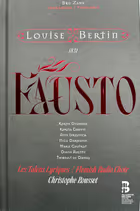
Louise Bertin: Fausto
- Composer
- Louise Bertin
- Artist
- Les Talens Lyriques, Flemish Radio Choir / Christophe Rousset
- Label
- Palazzetto Bru Zane
- Catalogue
- BZ 1054
Christophe Rousset and Les Talens Lyriques’s recording of Louise Bertin’s Fausto, released in 2024 on the specialist French-Romantic-repertoire label Palazzetto Bru Zane, won the BBC Music Magazine Opera Award in 2025. It’s a genuine rediscovery: an opera unheard since three performances in 1831.
About the opera
Bertin composed Fausto — an opera semiseria in four acts based on Goethe’s Faust, sung in Italian to her own libretto (written in French and translated by the Théâtre-Italien’s chief librettist, Luigi Balocchi) — at the age of 21. It premiered at Paris’s Théâtre-Italien on 7 March 1831, following delays that had originally been scheduled to bring it to the stage the year before. Contemporary reception was reportedly fairly kind, with particular praise for the originality of the score, but the opera disappeared from the playbill after just three performances and was never revived. The score then sat largely unperformed in the vaults of the Bibliothèque Nationale de France for close to 190 years.
Why it mattered then, and now
Fausto’s reception, however brief its stage life, won Bertin the admiration of Victor Hugo — a connection that helped open the door to a second opera, La Esmeralda, staged at the Paris Opéra in 1836 with a libretto adapted from Hugo’s own Notre-Dame de Paris. That a woman composer secured a grand-opera staging in 1830s Paris at all was itself a rarity; very few of her female contemporaries achieved anything comparable in a musical establishment almost entirely closed to them. This recording, and the modern staged revival that accompanied it, represent one of the more significant rediscoveries in recent French Romantic-opera scholarship — not a minor curiosity but a real, structurally ambitious four-act score that had simply never had the chance to be heard again.
About the performers
Christophe Rousset and Les Talens Lyriques, the period-instrument ensemble he founded in 1991, have built much of their reputation on exactly this kind of repertoire archaeology — bringing genuinely forgotten French operatic and instrumental music back into circulation through historically informed performance. Palazzetto Bru Zane, a Venice-based foundation dedicated specifically to French Romantic music, has become one of the most consistent sources for this kind of rediscovery on disc, pairing scholarly editions with fully staged, recorded productions rather than concert excerpts.
Why rediscoveries like this matter
Fausto belongs to a broader pattern of scholarly and commercial interest, over the past two decades, in reviving 19th-century operas that fell out of the repertoire not because of any obvious lack of musical quality but because of the accidents of performance history — a thin initial run, a composer who didn’t survive long enough to champion a revival, or simply the practical difficulty of reviving a large-scale staged work without institutional backing. Palazzetto Bru Zane’s entire catalogue is built around exactly this kind of recovery work, and a rediscovery specifically by a woman composer working in a field almost entirely closed to them in 1830s Paris adds a further layer of significance beyond the music’s own merits — Fausto is one of vanishingly few surviving examples of what a woman composer was able to achieve on the Parisian operatic stage in this period at all.
A note on this page
This review was written fresh for mmmusic to cover a real, current recording — it isn’t part of the site’s recovered 1991–2018 archive. It’s new coverage of what’s actually being recorded and recognised today, built from independently verified facts about the opera and its history.
Questions about this recording
What is Fausto and when was it written?
An 1831 opera semiseria in four acts by the French composer Louise Bertin, based on Goethe's Faust, premiered at the Théâtre-Italien in Paris on 7 March 1831.
Why is this recording significant?
The opera ran for only three performances after its premiere and was never staged again — the score sat in the Bibliothèque Nationale de France for nearly 190 years before this recording and its accompanying modern revival brought it back.
Who was Louise Bertin?
A French composer who wrote Fausto at just 21. Its reception won her the admiration of Victor Hugo, which helped open the door to her second opera, La Esmeralda (1836), staged at the Paris Opéra with a libretto based on Hugo's own novel.
Is this recording still available to buy?
Yes — Palazzetto Bru Zane's catalogue number BZ 1054 remains findable through the label and classical retailers. We don't run an in-house shop, so we link out to Amazon and Discogs below.


