CD Review
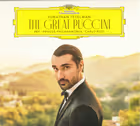
Giacomo Puccini: The Great Puccini, Jonathan Tetelman, tenor
- Composer
- Giacomo Puccini
- Artist
- Jonathan Tetelman, tenor
- Label
- Deutsche Grammophon
- Catalogue
- 00289 486 4683
Jonathan Tetelman’s The Great Puccini, released on Deutsche Grammophon in 2023, is a single-composer aria recital that won the 2024 Gramophone Voice & Ensemble Award, a significant recognition for a tenor whose career up to that point had been built substantially on stage work at major opera houses rather than an existing recording career. The Chilean-American tenor draws the recital’s fifteen tracks entirely from Puccini, spanning Manon Lescaut, Turandot, La rondine, La bohème, Tosca, Madama Butterfly, La fanciulla del West, Il tabarro, and Le villi, Puccini’s first opera, rarely excerpted alongside his more famous later work.
The programme is sequenced by opera rather than strict chronology, moving from Manon Lescaut’s “Donna non vidi mai” through Turandot’s “Nessun dorma”, La rondine’s “Parigi! È la città dei desideri”, a three-part sweep through La bohème (“Che gelida manina”, “O soave fanciulla”, “Dunque è proprio finita”), two scenes from Tosca (“Recondita armonia” and “E lucevan le stelle”), a return to Manon Lescaut for “Ah! Manon, mi tradisce”, Madama Butterfly’s “Io so che alle sue pene”, two numbers from the less frequently recorded La fanciulla del West, Il tabarro’s “O Luigi!”, a second pass at Turandot with “Non piangere, Liù”, and finally Le villi’s “Torna ai felici dì”, closing, rather than opening, with Puccini’s earliest opera, a sequencing choice that reads as a deliberate look back at where his voice as a composer began.
Building a recital entirely around one composer rather than a mixed programme is a specific kind of statement for a tenor still establishing a recording profile: Puccini wrote almost exclusively for the most lyrical, dramatically direct register of the tenor voice, so a single-composer disc lets a singer demonstrate range across an entire compositional career, from the more Verdian, still-developing voice of Le villi through to the unfinished Turandot, Puccini’s last and most harmonically adventurous opera, rather than switching between different composers’ technical and stylistic demands from track to track. Including the Le villi excerpt specifically signals a recital built with some curatorial ambition, rather than simply collecting Puccini’s most famous individual hits (Nessun dorma, Che gelida manina, and E lucevan le stelle are all present too, but positioned within a fuller career survey rather than as the whole programme).
About Jonathan Tetelman
Tetelman’s profile before this recording had been built mostly through stage appearances, a career trajectory shared by many opera singers whose reputations are made primarily in the house rather than on disc, in contrast to singers who build a substantial recording career in parallel with stage work from early on. A major-label solo recital on Deutsche Grammophon represented a significant step toward a more conventional recording profile, and winning a Gramophone award with it is a strong early signal for a tenor still relatively new to a discography-focused career.
About the programme
Sequencing a single-composer recital chronologically, or with real attention to a composer’s stylistic development, is a more demanding curatorial task than it might look, it requires committing to material outside the two or three most famous arias by that composer, since a purely greatest-hits sequence would read as thinner and less distinctive. Including Le villi and Il tabarro alongside the guaranteed highlights from Bohème, Tosca, and Turandot suggests a recital built to say something about Puccini’s full career rather than simply assembling his best-known moments.
A note on this page
This review was written fresh for mmmusic, covering a real, current recording released years after the original 1991–2018 shop closed, it isn’t part of the site’s recovered archive. We’ve written it from verified facts about the recording, the performer, and the award it won, extending the kind of coverage the original site gave to notable classical releases to what’s actually being recorded and recognised today.
Questions about this recording
Who is Jonathan Tetelman?
A Chilean-American tenor whose career, before this recital, had been built primarily on stage appearances at major opera houses rather than a substantial existing discography, this was his first major-label solo recording.
What arias are on the disc?
Fifteen tracks drawn entirely from Puccini, opening with Manon Lescaut's "Donna non vidi mai" and closing with Le villi's "Torna ai felici dì", covering Manon Lescaut, Turandot, La rondine, La bohème, Tosca, Madama Butterfly, La fanciulla del West and Il tabarro along the way, including the guaranteed highlights "Nessun dorma", "Che gelida manina" and "E lucevan le stelle".
What did it win?
The 2024 Gramophone Voice & Ensemble Award.
Why record a single-composer recital rather than a mixed programme?
Puccini wrote almost exclusively for the tenor voice's most lyrical and dramatically expressive register, so a single-composer disc lets a tenor demonstrate range across an entire career's stylistic development, from the early Le villi through to the late, unfinished Turandot, rather than jumping between different composers' vocal demands.


