CD Review
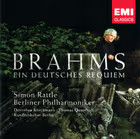
Brahms: Ein deutsches Requiem, Dorothea Röschmann, Thomas Quasthoff
- Composer
- Brahms
- Artist
- Dorothea Röschmann, Thomas Quasthoff; Rundfunkchor Berlin; Berlin Philharmonic / Simon Rattle
- Label
- EMI Classics
- Catalogue
- 0946 3 65393 2 4
- Reviewed by
- Anne McAlister
Brahms’s German Requiem avoids the liturgical Requiem text entirely. His skilfully-selected biblical texts on the theme of human mortality avoid all mention of Christ; this is a Requiem to provide comfort and consolation to the bereaved, not to pray for the peace of the souls of the dead. Given the popularity of the work in the choral repertoire (not to mention the fact that it is Brahms’s largest single composition), it is surprising how few really good recordings of it exist. Fortunately, Simon Rattle has at his disposal not only an orchestra steeped in the German romantic tradition, but also the Rundfunkchor Berlin (Germany’s oldest radio choir) and two world-class soloists in Dorothea Röschmann and Thomas Quasthoff. He brings fresh ideas to bear on the piece, particularly with regard to tempi. Thus the Langsam marking of the slow second movement is truly slow, the choral tone desolate, and the build-up of tension all the more effective. In contrast, the fourth movement Wie lieblich sind deine Wohnungen (How lovely are thy tabernacles) is taken markedly faster than normal. At the phrase “die loben dich immerdar” Rattle even emphasises some hemiolas that have rarely (if ever) been marked before, to interesting effect.
The chorus is one of the finest; perfectly balanced, with beauty of tone across all the voices and no sense of strain anywhere. Even better, they constantly convey the sense of the words; “werden mit Freuden” in the first movement is truly joyful, as is the triumphant moment ten minutes into the second movement when the mood changes from resignation to radiant hope. Röschmann’s voice arches gloriously over the orchestra in the fifth movement. Her words occasionally disappear at the top of her range, but Quasthoff’s diction is excellent and his delivery noble throughout. Overall, there is a great feeling of unity in this performance, probably helped by Rattle’s decision to place the chorus on the stage rather than in the Berlin Philharmonie’s choir stalls above the stage. Such is the beauty and passion of this Brahms Requiem, it must be considered one of the finest ever recorded.
A note on this page
Originally published by Anne McAlister, recovered from mmmusic's own archive and reproduced here as the critic wrote it.
Questions about this recording
Why does Brahms's Requiem avoid the traditional liturgical text?
Brahms selected his own biblical texts on the theme of human mortality, avoiding all mention of Christ. The result is intended to comfort and console the bereaved, rather than to pray for the souls of the dead in the traditional liturgical sense.
Who are the soloists and choir on this recording?
Soprano Dorothea Röschmann and baritone Thomas Quasthoff, with the Rundfunkchor Berlin, Germany's oldest radio choir, and the Berlin Philharmonic under Simon Rattle.
What's distinctive about Rattle's tempo choices here?
The review singles out an unusually slow second movement and a markedly faster fourth movement ("Wie lieblich sind deine Wohnungen") than is typical, along with hemiola emphases in the second movement rarely marked by other conductors.
Is this recording still available to buy?
Yes, EMI's catalogue number 0946 3 65393 2 4 remains findable through classical retailers. We don't run an in-house shop, so we link out to Amazon and Discogs below.


