CD Review
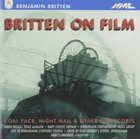
Britten: Britten on Film: Night Mail, Coal Face & Other Film Scores
- Composer
- Britten
- Artist
- Simon Russell Beale (narrator); Mary Carewe; Birmingham Contemporary Music Group / Brabbins
- Label
- NMC
- Catalogue
- NMC D112
- Reviewed by
- Anne McAlister
Compared with such composers as Vaughan Williams and Bax, Benjamin Britten’s involvement with film music was early and brief. With one isolated exception (Instruments of the Orchestra, 1945) his contribution was confined to the years 1935–36, during which he worked for (among others) the government-sponsored GPO Film Unit, where an enterprising director soon paired him with the young WH Auden. This disc brings together for the first time a comprehensive collection of Britten’s surviving music from that period. The scores for this recording have been specially reconstructed from manuscript and other sources held at the Britten-Pears Library.
The CD features a new performing edition of The Way to the Sea along with premiere recordings of Coal Face, Men Behind the Meters, Negroes, Peace of Britain, The King’s Stamp and Telegrams, plus the first recording of the complete music to Night Mail. The last-mentioned was the most celebrated documentary of the 1930s; for the film’s ending Auden provided a virtuoso verse commentary, “This is the night mail crossing the border”, narrated here in under-stated fashion by Simon Russell Beale. (It should be mentioned that the “complete” music includes only two further sequences lasting a mere 1’42”!)
Negroes was an ambitious project concerned with the slave trade and its abolition. It was shelved in 1935, although revived in modified form in 1938. This recording restores Auden’s and Britten’s original concept for the soundtrack, in which conventional commentary is replaced by sung recitative. The effect is similar to being plunged into Curlew River or one of Britten’s operas. The King’s Stamp, Britten’s first film score, displays his early grasp of several cinematic techniques, including his ability to present one or two motifs in the opening title music which are then used to generate much of the subsequent material.
Durations for some of the film music featured are brief, Telegrams, Peace of Britain and Men behind the Meters combined notch up a total of just over seven minutes, but everywhere there are glimpses of Britten’s later mature style. It seems that his experience gained in making the best of limited musical resources fostered not only the resourceful scoring of his subsequent chamber operas but also his lifelong preference for a pared-down, slender sound. The booklet notes about each film are highly informative.
(NB: Britten’s sole feature film score, Love from a Stranger, is available on an earlier NMC disc, NMCD073.)
A note on this page
Originally published by Anne McAlister, recovered from mmmusic's own archive and reproduced here as the critic wrote it.
Questions about this recording
When did Britten write music for film?
Almost entirely in 1935-36, working for the government-sponsored GPO Film Unit (with one later exception, Instruments of the Orchestra in 1945), a brief period during which he was paired with the young poet WH Auden.
What's a highlight of this collection?
The first recording of the complete music to Night Mail, the most celebrated documentary of the 1930s, whose famous closing verse commentary by Auden is narrated here by Simon Russell Beale.
How were these scores prepared for recording?
They were specially reconstructed from manuscript and other sources held at the Britten-Pears Library, since the surviving material for several of the scores was incomplete or scattered.
Is this recording still available to buy?
Yes, NMC's catalogue number NMC D112 remains findable through the label and classical retailers. We don't run an in-house shop, so we link out to Amazon and Discogs below.


