
CD Review
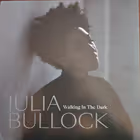
Various composers: Walking in the Dark, Julia Bullock, soprano
- Composer
- Various (Barber, Adams, Taylor, Brown Jr. Converse, Denny, traditional)
- Artist
- Julia Bullock, soprano; Christian Reif; Philharmonia Orchestra
- Label
- Nonesuch
- Catalogue
- 075597908183
Julia Bullock’s Walking in the Dark, released on Nonesuch in 2022, is her debut solo album, made with conductor Christian Reif and the Philharmonia Orchestra, and it won Bullock her first Grammy, for Best Classical Solo Vocal Album, in 2024. What makes the programme distinctive is what it deliberately isn’t: rather than the 19th-century European art-song repertoire most sopranos build a first recital disc around, Bullock built hers entirely from 20th- and 21st-century American material, spanning orchestral song, a traditional spiritual, and popular song reworked for voice and orchestra.
The programme includes Samuel Barber’s Knoxville: Summer of 1915 (1947), a setting of James Agee’s prose memoir of childhood evening in the American South that’s become one of the most performed American orchestral song settings of its era, alongside an excerpt from John Adams’s El Niño (Memorial de Tlatelolco, 2000). Around those two more conventionally “classical” pieces, Bullock builds outward into American vernacular song: the traditional spiritual City Called Heaven, Oscar Brown Jr.’s Brown Baby, Connie Converse’s One by One, Billy Taylor and Dick Dallas’s civil-rights-era standard I Wish I Knew How It Would Feel to Be Free, and Sandy Denny’s Who Knows Where the Time Goes, songs drawn from folk, jazz, and singer-songwriter traditions rather than from the classical concert repertoire, all arranged for voice and orchestra to sit alongside Barber and Adams without a stylistic seam.
About Julia Bullock
Bullock is an American soprano whose career prior to this recording had been built substantially on staged opera and highly curated concert programming rather than a conventional recital-disc trajectory, she’s known for building programmes around thematic or political through-lines rather than a straightforward chronological survey of repertoire. Walking in the Dark extends that same instinct into her first full solo studio release: the choice to centre American song specifically, and to place a spiritual and civil-rights-era songs on equal footing with Barber and Adams rather than as a supplementary “crossover” gesture, is itself a considered artistic statement about what belongs in the concert-song canon.
About the programme’s throughline
Pairing Connie Converse, a singer-songwriter largely unknown in her own lifetime, working in the 1950s in a style that predates the American folk revival she’s now retrospectively associated with, alongside an established 20th-century orchestral-song landmark like Barber’s Knoxville is a genuinely unusual piece of programming for a classical vocal release. It treats vernacular American song and formally “classical” American song as belonging to the same continuous tradition rather than separate, hierarchically ranked categories, which is arguably the record’s central curatorial argument.
About Knoxville: Summer of 1915
Barber’s setting of James Agee’s prose text, itself the prologue to Agee’s autobiographical novel A Death in the Family, written from an adult narrator’s memory of a single quiet evening in childhood, is one of the most performed American works for soprano and orchestra, and its presence here anchors the recital’s more overtly “classical” end. Placing it alongside vernacular material by songwriters like Connie Converse, who had almost no public recognition in her own working life and vanished mysteriously in the 1970s, only to be rediscovered decades later through recordings unearthed by later listeners, gives the programme a real sense of curatorial argument rather than a simple genre-crossing gesture: both pieces are treated as equally serious American song, regardless of how differently each composer’s career and posthumous reputation unfolded.
A note on this page
This is a freshly written review of a real, current recording, not a page recovered from mmmusic’s 1991–2018 archive, the album was released years after the original shop closed. We’ve written it from verified facts about the recording’s programme, its performers, and the award it won, to extend the kind of coverage the original site gave to notable classical releases to what’s genuinely being recorded and recognised now.
Questions about this recording
Is this Julia Bullock's debut recording?
It's her debut solo album, she had appeared on other recordings and in staged opera productions before this, but Walking in the Dark was her first release built entirely around her own programme as a soloist.
What's the programme built around?
Twentieth- and twenty-first-century American song and orchestral song, rather than the standard 19th-century European art-song repertoire most vocal recital discs draw on, including Samuel Barber's Knoxville: Summer of 1915, an excerpt from John Adams's El Niño, a traditional spiritual, and songs by Oscar Brown Jr. Connie Converse, Billy Taylor, and Sandy Denny.
What did it win?
The 2024 Grammy Award for Best Classical Solo Vocal Album, Bullock's first Grammy win.
Who accompanies her on the recording?
Conductor Christian Reif and the Philharmonia Orchestra.


