
CD Review
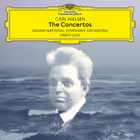
Carl Nielsen: The Concertos
- Composer
- Carl Nielsen
- Artist
- Danish National Symphony Orchestra / Fabio Luisi; Bomsori Kim, violin; Johnny Teyssier, clarinet; Ulla Miilmann, flute
- Label
- Deutsche Grammophon
- Catalogue
- 00028948634873
Carl Nielsen wrote concertos for three different solo instruments across roughly two decades, a Violin Concerto in 1911, a Flute Concerto in 1926, and a Clarinet Concerto in 1928, and while each is performed and recorded individually often enough, hearing all three together, played by the composer’s own national orchestra, makes an unusually direct case for Nielsen as a genuinely distinctive concerto composer rather than someone working in Sibelius’s or Brahms’s shadow. This Deutsche Grammophon release, with the Danish National Symphony Orchestra under Fabio Luisi, won the Concerto Award at the 2024 BBC Music Magazine Awards.
About the concertos
The three works sit at different points in Nielsen’s late style and show real variety in how he treats a soloist against an orchestra. The Violin Concerto, the earliest of the three, is the most conventionally virtuosic and Romantic in cast. The Flute Concerto is famously unsettled and asymmetrical, it doesn’t resolve in the key it starts in, and its wandering, unpredictable trombone interruptions have become one of the work’s best-known features. The Clarinet Concerto, the latest and often considered the most demanding of the three, pushes the soloist against a persistent, needling snare drum that recurs throughout the piece, creating a sustained tension between soloist and orchestra unlike almost anything else in the standard concerto repertoire. Recording all three together lets a listener trace how differently Nielsen approached the same basic problem, a solo instrument set against an orchestra, work to work.
About the performers
Fabio Luisi, the Italian conductor who also serves as principal conductor of the Metropolitan Opera and general music director of the Dallas Symphony Orchestra, has led the Danish National Symphony Orchestra since 2017, and this concerto cycle caps a broader survey of Nielsen’s orchestral music undertaken during his tenure there (the orchestra has separately recorded Nielsen’s symphonies with Luisi for the label Orchid Classics). The three soloists, violinist Bomsori Kim, clarinettist Johnny Teyssier and flautist Ulla Miilmann, are each drawn primarily from within the Danish musical world rather than assembled as touring international soloists, which suits a project framed around a national orchestra’s ownership of its own composer’s music.
About Nielsen
Carl Nielsen (1865–1931) is Denmark’s most celebrated composer, and his six symphonies and handful of concertos occupy roughly the position in Danish musical life that Sibelius’s do in Finland’s, a national figure whose work sits at the centre of the country’s own orchestral canon, even as international recognition, outside these three concertos and the Fourth and Fifth Symphonies especially, has come more slowly than for some of his early-20th-century contemporaries. Born into a poor rural family on the island of Funen, he worked initially as a military bandsman before training at the Copenhagen Conservatory, and spent much of his career as a working violinist and conductor in Danish orchestral life alongside composing, a practical, inside-the-orchestra vantage point that shows in how idiomatically and demandingly he writes for solo wind and brass instruments across his output, this trio of concertos very much included.
The Danish National Symphony Orchestra itself carries a particular institutional weight in this context: it’s the radio orchestra of DR (Danmarks Radio), Denmark’s national broadcaster, a lineage that has kept it closely tied to Danish musical life and repertoire across its history in a way a purely commercial or civic orchestra might not be. Recording the composer most closely associated with Danish national musical identity, under a chief conductor with the international standing Luisi brings from his other posts, gives this concerto cycle a claim to institutional authority on the repertoire that a foreign orchestra recording the same three works simply couldn’t carry in quite the same way.
A note on this page
This is a freshly written review of a real, current recording, not a page recovered from mmmusic’s original archive, the shop closed in 2018, well before this release. One correction worth flagging explicitly: some secondary sources conflate this Deutsche Grammophon concerto recording with Luisi and the same orchestra’s separate Nielsen symphony cycle on Orchid Classics, we’ve verified the label and catalogue details above directly against Deutsche Grammophon’s own release information rather than repeating that mix-up.
Questions about this recording
Which three Nielsen concertos are on this recording?
The Violin Concerto, Op. 33; the Flute Concerto; and the Clarinet Concerto, Op. 57, three separate works for three different soloists, recorded together as a single release rather than paired individually with other composers.
Who are the soloists?
Violinist Bomsori Kim, clarinettist Johnny Teyssier and flautist Ulla Miilmann, each performing with the Danish National Symphony Orchestra under Fabio Luisi rather than as an assembled all-star lineup from outside the orchestra.
Is this label correct, some listings mention Orchid Classics instead of Deutsche Grammophon?
This specific recording, the complete concerto cycle with Kim, Teyssier and Miilmann, is a Deutsche Grammophon release. Fabio Luisi and the Danish National Symphony Orchestra have also recorded Nielsen's symphonies for the separate label Orchid Classics as part of the same broader Nielsen project; the two shouldn't be confused.
Why does a Danish orchestra have a particular claim on Nielsen's concertos?
Carl Nielsen is Denmark's most celebrated composer, and the Danish National Symphony Orchestra (branded in Danish as DR SymfoniOrkestret) is the country's leading symphony orchestra, this recording caps a multi-year Luisi-led survey of Nielsen's orchestral output by his own national orchestra.


