CD Review
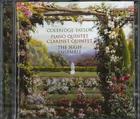
Coleridge-Taylor: Piano Quintet, Op. 1 / Clarinet Quintet, Op. 10
- Composer
- Coleridge-Taylor
- Artist
- Nash Ensemble
- Label
- Hyperion
- Catalogue
- CDA67590
- Reviewed by
- Dawn Cooke
Until beginning research into this disc, the reviewer was convinced that nothing of any cultural value could ever have come out of Croydon, having lived there for several years, and sits happily corrected on learning that Samuel Coleridge-Taylor lived there for a significant part of his life. From an early age Coleridge-Taylor showed an extraordinary aptitude for the violin, and he enrolled at the Royal College of Music in 1890 to study the instrument; it was there that his interest in composition developed. He went on to study with Stanford and was regarded as one of his most brilliant students, high praise indeed when one considers that Stanford also taught Bliss, Bridge, Holst, Howells, Ireland, Moeran and Vaughan Williams.
It was in 1893 that the Piano Quintet received its first public performance. The critic of the Croydon Advertiser used the word “astonishing” in his review, but sadly it seems the quintet was not played again for another 100 years. The revival of works like this, and the Ballade for violin and piano (which has a majestic yet serene quality), is of real interest because they display the makings of a great composer, but it is the final work on the disc that is its jewel.
The Clarinet Quintet was written in 1895 as a response to Stanford’s comment that after Brahms’s, no one would be able to write a quintet uninfluenced in some way by his. Coleridge-Taylor took up the challenge, and on inspecting the result Stanford remarked, “you’ve done it, me boy!” On hearing this work for the first time, it struck the reviewer as quite extraordinary that it has not been performed more frequently, it would make an inspired coupling with the Brahms, for instance. The first movement, Allegro energico, opens with a punchy clarinet theme that sets the tone for the whole; then comes the Larghetto affetuoso, which starts with a homogenous string background over which the clarinet presents its theme, developing with a delicate English pastoral quality that is uncommonly beautiful. The final two movements are based on folk-like material, the Scherzo delightfully playful in nature while the Allegro Agitato sounds Dvořákian in places, hardly surprising, since Dvořák was a composer much admired by Coleridge-Taylor.
The Nash Ensemble plays with their usual brilliance and conviction, and this disc is heartily recommended to any chamber music enthusiast.
A note on this page
Originally published by Dawn Cooke, recovered from mmmusic's own archive and reproduced here as the critic wrote it.
Questions about this recording
Who was Samuel Coleridge-Taylor?
A composer who lived for a significant part of his life in Croydon, and who enrolled at the Royal College of Music in 1890 to study violin before his interest turned to composition, he studied with Stanford, whose other pupils included Bliss, Bridge, Holst, Howells, Ireland, Moeran and Vaughan Williams.
What's the story behind the Piano Quintet?
It received its first public performance in 1893, praised as "astonishing" by the Croydon Advertiser's critic, but it then went unplayed for roughly another 100 years before this recording's era of revival.
Why is the Clarinet Quintet described as the jewel of the disc?
It was written in 1895 partly as a response to Stanford's remark that after Brahms's own clarinet quintet, no one would be able to write one uninfluenced by it, on hearing the result, Stanford is quoted as saying "you've done it, me boy!"
Is this recording still available to buy?
Yes, Hyperion's catalogue number CDA67590 remains findable through the label and classical retailers. We don't run an in-house shop, so we link out to Amazon and Discogs below.


