CD Review
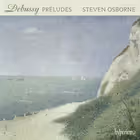
Debussy: Préludes, Books 1 & 2, Steven Osborne, piano
- Composer
- Debussy
- Artist
- Steven Osborne, piano
- Label
- Hyperion
- Catalogue
- CDA67530
- Reviewed by
- Ruth Squire
“There is no theory. You merely have to listen. Pleasure is the law.” Debussy’s attitude to composition has tested pianists for decades. For many, the ability to capture Debussy’s spontaneity is too challenging, but not Steven Osborne, whose recent survey of Debussy’s Préludes is a welcome addition to his repertoire. His foreword to the music rightly describes the challenge of these pieces as “prodigious.” Osborne’s hard work has certainly paid off; he sounds at ease with the music, almost languid in places, throughout the performances. He has captured Debussy’s quintessential atmosphere: both hazy (just listen to Des pas sur la neige, Book 1) and sparkly (La danse de Puck, Book 2).
Deutsche Grammophon’s earlier Michelangeli recordings, which are, for many, viewed as the recording of choice, seem distinctly dated by comparison. The clarity of sound found on Osborne’s recording is not matched by Michelangeli’s. In addition, Michelangeli’s periodic rubato interferes with the music too much for my taste. Osborne has proven that it is possible to create a relaxed atmosphere without pulling the music around.
Many Debussy fans will have been following Noriko Ogawa’s volumes (of which there are now three) with great interest; she also has captured the light, delicate ambience of Debussy’s musical world. However, I feel that there is a greater variety of sound and texture from Osborne, making for a more interesting and personal performance. Hyperion’s accompanying sleeve-notes are very useful, giving each Prélude a context. In his introduction, Steven Osborne wonders if players “knew what they were getting themselves into” when embarking on La cathédrale engloutie. I think he certainly did, the mood is simply magical. I, for one, am now hoping that Hyperion and Osborne continue their Debussy survey.
About the pianist
Steven Osborne is a Scottish pianist, born in 1971, who studied at St Mary’s Music School in Edinburgh and the Royal Northern College of Music in Manchester before winning first prize at the 1991 Clara Haskil Competition and the 1997 Naumburg International Competition. He has recorded for Hyperion since 1998 across a wide repertoire spanning Beethoven, Ravel, Prokofiev, Rachmaninov and Messiaen, alongside his ongoing survey of Debussy’s solo piano music. He was appointed OBE for services to music in 2022, and holds visiting professorships at the Royal Academy of Music and the Royal Conservatoire of Scotland.
A note on this page
Originally published by Ruth Squire, recovered from mmmusic's own archive and reproduced here as the critic wrote it.
Questions about this recording
How does Osborne's recording compare to Michelangeli's classic account?
The review finds Osborne's sound clearer and less mannered, it singles out Michelangeli's periodic rubato as interfering with the music, where Osborne creates a relaxed atmosphere without pulling the tempo around.
Does this cover both books of Préludes?
Yes, both Book 1 and Book 2, complete, on a single disc.
How does Osborne's approach compare to Noriko Ogawa's Debussy recordings?
The review, comparing it to Ogawa's ongoing Debussy volumes for BIS, finds Osborne brings a greater variety of sound and texture, making for what it calls a more interesting and personal performance.
Is this recording still available to buy?
Yes, Hyperion's catalogue number CDA67530 remains findable through classical retailers. We don't run an in-house shop, so we link out to Amazon and Discogs below.


