CD Review
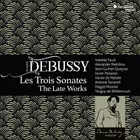
Claude Debussy: Les Trois Sonates (The Late Works)
- Composer
- Claude Debussy
- Artist
- Isabelle Faust, Alexander Melnikov, Jean-Guihen Queyras, Xavier de Maistre, Magali Mosnier and others
- Label
- Harmonia Mundi
- Catalogue
- HMM 902303
Isabelle Faust’s Harmonia Mundi recording of Debussy’s late chamber sonatas, released for the composer’s 2018 centenary, won the Gramophone Chamber Award in 2019 — recognition for a project that assembles a genuine cast of first-call soloists rather than relying on one fixed ensemble.
About the programme
Debussy conceived a set of six sonatas for varied chamber combinations as his final major project, intending them as a kind of summation and a deliberately French statement written during wartime — each was signed “musicien français.” He completed only three before his death from cancer in March 1918: the Sonata for Cello and Piano (1915), the Sonata for Flute, Viola and Harp (1915) — an unusual, harmonically spare combination Debussy chose specifically for its coloristic possibilities — and the Violin Sonata (1917), his last finished work. This disc also includes several of Debussy’s late solo piano miniatures from the same period, filling out a portrait of a composer working under the shadow of terminal illness and a war he felt intensely.
About the performers
Because the three sonatas require entirely different instrumental forces, no single quartet or trio could record all of them — instead, the project draws on individually prominent chamber musicians for each piece: violinist Isabelle Faust and pianist Alexander Melnikov for the Violin Sonata, cellist Jean-Guihen Queyras alongside Melnikov for the Cello Sonata, and flautist Magali Mosnier, violist Antoine Tamestit and harpist Xavier de Maistre for the Flute, Viola and Harp Sonata. Faust, a German violinist with an unusually wide-ranging discography spanning Bach to contemporary commissions, anchors the project and gives it its name, but the recording is really a collective statement by several of the most recorded chamber musicians of their generation working on the same late-Debussy material.
The sound world of the sonatas
Each of the three sonatas has its own distinct character shaped directly by its unusual instrumentation. The Cello Sonata, the earliest of the three, is spare and often astringent, with a central movement marked “Sérénade” that treats the cello almost like a guitar, plucked and percussive rather than singing. The Sonata for Flute, Viola and Harp — a combination Debussy chose specifically for its coloristic possibilities rather than any established chamber tradition — produces some of the most delicate, translucent textures in his entire output, closer to the shifting light-effects of his orchestral writing than to conventional chamber music. The Violin Sonata, finished only months before Debussy’s death, is more overtly emotional and unsettled than the other two, its finale marked “Très animé” arriving after passages of real harmonic ambiguity that many listeners have read as reflecting the composer’s own physical and mental state while writing it.
Why this recording is distinctive
Because assembling the right personnel for all three works in one project is logistically demanding — no standing ensemble naturally covers violin, cello, flute, viola and harp at this level simultaneously — recordings that gather genuinely first-rank soloists for every single sonata, rather than compromising on one or two players, are relatively rare. This project’s roster of Faust, Melnikov, Queyras, de Maistre, Tamestit and Mosnier represents exactly that kind of assembled dream cast, which is part of why the recording drew the level of critical attention it did on release.
A note on this page
This review was written fresh to cover a real, award-winning recording — it’s new coverage rather than part of the archive recovered from mmmusic’s original 1991–2018 run, extending the same standard of factual reporting to what’s being recorded and recognised today.
Questions about this recording
What are 'Les Trois Sonates'?
Debussy's planned final project: six sonatas for different chamber combinations, of which he completed only three before his death in 1918 — the Violin Sonata, the Sonata for Flute, Viola and Harp, and the Cello Sonata. This disc gathers all three, alongside shorter solo piano pieces from the same late period.
Under what circumstances did Debussy write these works?
During the First World War, while suffering from the colorectal cancer that would kill him in March 1918. He signed the scores 'Claude Debussy, musicien français' — a deliberately patriotic gesture during the war — and completed the Violin Sonata, his last finished composition, only months before he died.
Why use an ensemble of soloists rather than a fixed chamber group?
Because each of the three sonatas is scored for a different combination of instruments, no single fixed ensemble can play all of them — the recording instead brings together separate first-call soloists (violin, cello, flute, viola, harp, piano) for each individual work.
Is this recording still available to buy?
Yes — Harmonia Mundi's catalogue number HMM 902303 remains available through the label and classical retailers. We don't run an in-house shop, so we link out to Amazon and Discogs below.


