CD Review
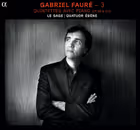
Gabriel Fauré: Piano Quintets, Eric Le Sage, piano
- Composer
- Gabriel Fauré
- Artist
- Eric Le Sage, piano; Quatuor Ébène
- Label
- Alpha
- Catalogue
- Alpha 602
- Reviewed by
- Sabine Koch
Fauré’s first and second piano quintets represent music that may be conceived as French in essence. They are works where musical and technical intellect is combined with sensual sensibility. The musical structures are thoroughly thought through and serve expressive needs that, according to the French musicologist Nicolas Southon, attempt “to lay bare the truth of the soul.” While Op. 89 features tightly woven counterpoint, Op. 115 exhibits a complex harmony that verges on atonality. At the same time, diverse orientations of the human soul and heart are being touched upon.
The Quatuor Ébène’s and Eric Le Sage’s playing does full justice to the music’s technical and emotional requirements. The clearly executed arpeggi in the first movement of Op. 89 express and evoke ethereal rapture which dissolves into melancholy through the dedicated contribution of the strings. In its playfulness and thoughtfulness, the Adagio conjures up associations of a lullaby. In the second piano quintet, the gaiety and drama in the vivacious melody and minor harmony in the Allegretto moderato finale are superseded by affects that encompass nostalgia and despair (movement 1) as well as adventurous fantasy expressed in virtuosic whole-tone progressions (movement 2). These moods find their conclusion in the Andante moderato (a lament of some kind), and a final movement of rather whimsical character that results from alternations between major and minor.
About the performers
The Quatuor Ébène, founded in France in 1999, built its international reputation on a stylistic range unusually broad for a string quartet, equally at home in core Classical and Romantic repertoire and in jazz and film-score crossover projects, several of which have appeared on their own recordings. Eric Le Sage, their collaborator here, is a French pianist particularly associated with chamber-music partnerships and the core French piano repertoire, including a substantial recorded survey of Schumann. Fauré wrote his two piano quintets nearly three decades apart, the first largely in the 1890s, the second not completed until 1921, two years before his death, a gap wide enough that the two works are often heard as representing genuinely different phases of his harmonic language, exactly the contrast this recording sets out to capture by pairing them on one disc.
The musicians’ perfect teamwork accounts for the successful rendering of these moods and structural intricacies. What Le Sage has occasionally been accused of proves advantageous in this recording: in collaboration with the other instrumentalists he achieves his best in interpretation and expression, without dominating the music. The sound engineering reinforces the strengths of the performers, bringing all the instruments into balance but not downplaying the dynamic ranges that are laid down in Fauré’s score and fully exploited by all instrumentalists.
A note on this page
Originally published by Sabine Koch, recovered from mmmusic's own archive and reproduced here as the critic wrote it.
Questions about this recording
What's on this recording?
Both of Fauré's piano quintets, No. 1 in D minor, Op. 89, and No. 2 in C minor, Op. 115, performed by pianist Eric Le Sage with the Quatuor Ébène.
How do the two quintets differ?
Op. 89 features tightly woven counterpoint, while the later Op. 115 exhibits a more complex harmony that verges on atonality, moving through nostalgia, despair and adventurous fantasy across its four movements.
Who is Eric Le Sage?
A French pianist known for his chamber-music collaborations; here his playing works in genuine partnership with the Quatuor Ébène rather than dominating the ensemble sound.
Is this recording still available to buy?
Yes, Alpha's catalogue number Alpha 602 remains findable through classical retailers. We don't run an in-house shop, so we link out to Amazon and Discogs below.


