
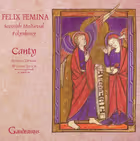
CD Review
Various composers: Felix Femina, Canty, dir. Rebecca Tavener
- Composer
- Various (Scottish medieval polyphony)
- Artist
- Canty, dir. Rebecca Tavener; William Taylor, clarsach
- Label
- Gaudeamus
- Catalogue
- CD GAU 360
- Reviewed by
- Anne McAlister
The “fortunate woman” of the disc’s title is, of course, the Blessed Virgin Mary. However, the excellent booklet notes make the point that it was the influence of another woman, St Margaret, the eleventh-century Queen of Scotland, that created the environment in which the music heard on this disc might flourish in Scotland. The manuscript from which the music is drawn contains the only significant body of polyphony from medieval Scotland, and has marginal transcriptions linking it to St Andrews. From the similar stylistic traits revealed by the settings it seems likely that, whatever the original sources of the music (some Continental, some British, some perhaps “local”), a local musician had a significant input in shaping the music. From the various Kyries, Alleluias, Sequences and related compositions, Canty’s director Rebecca Tavener has selected music suitable for a mass to the Virgin (a Ladymass, extremely popular in the 13th century) along with other appropriate works. The polyphonic material is all in two parts, so the disc presents a mixture of solo and unison chant and two-part polyphony, sometimes accompanied by William Taylor on a wire-strung clarsach or a symphonie. Taylor also provides attractive instrumental interludes. The singing is generally of a very high standard, the four female voices (all singers with vocal ensemble Cappella Nova) obviously used to working together and demonstrating great purity of tone. The acoustic of St Mary’s Parish Church, Haddington adds a warm glow to the sound.
About the ensemble
Canty is a Scottish vocal ensemble specialising in medieval and early Scottish sacred music, founded and directed by Rebecca Tavener, herself a longtime member of the pioneering early-music group Cappella Nova. Recordings drawing on the real, sparse surviving manuscript record of pre-Reformation Scottish polyphony, as this one does, represent a genuinely specialist repertoire; very little of it exists on disc elsewhere, making ensembles like Canty largely responsible for what recorded evidence of this music the public can actually hear.
A note on this page
Originally published by Anne McAlister, recovered from mmmusic's own archive and reproduced here as the critic wrote it.
Questions about this recording
What is Felix Femina?
A programme of Scottish medieval polyphony drawn from a manuscript containing the only significant surviving body of polyphonic music from medieval Scotland, with marginal transcriptions linking it to St Andrews.
Who is the 'fortunate woman' of the title?
The Blessed Virgin Mary, the disc's music is built around a Ladymass, a mass to the Virgin that was extremely popular in the 13th century.
Who performs on this recording?
Canty, directed by Rebecca Tavener, with four female voices drawn from the vocal ensemble Cappella Nova, joined by William Taylor on wire-strung clarsach and symphonie.
Is this recording still available to buy?
Yes, Gaudeamus's catalogue number CD GAU 360 remains findable through classical retailers. We don't run an in-house shop, so we link out to Amazon and Discogs below.


