
CD Review
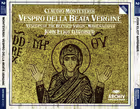
Claudio Monteverdi: Vespro della Beata Vergine (Vespers of 1610)
- Composer
- Claudio Monteverdi
- Artist
- Monteverdi Choir, English Baroque Soloists / Sir John Eliot Gardiner
- Label
- Archiv Produktion
- Catalogue
- 429 565-2
Sir John Eliot Gardiner’s 1990 recording of Monteverdi’s Vespers of 1610, made with the Monteverdi Choir and English Baroque Soloists, is widely regarded as a benchmark account of one of the most structurally ambitious works in the early sacred repertoire — recorded on period instruments in Venice’s Basilica di San Marco, the building most closely associated with Monteverdi’s own career.
About the work
Published in 1610 while Monteverdi was still working in Mantua, the Vespers combine psalm settings, sacred motets and a large-scale concluding Magnificat, scored for multiple vocal choirs, soloists and an unusually varied instrumental ensemble — a scale of ambition that set it apart from most sacred music of its era and helped establish the more dramatically expressive, texturally varied style Monteverdi would carry into his later work in Venice. Its combination of intimate solo writing and grand polychoral splendour has made it a cornerstone of the early-music revival, a piece performing groups return to repeatedly as both a historical touchstone and a genuine test of ensemble virtuosity.
About the performers
John Eliot Gardiner’s connection to this specific piece runs deeper than most conductor-repertoire pairings: he founded the Monteverdi Choir in 1964, while still a student at Cambridge, for the explicit purpose of performing the Vespers — meaning the ensemble’s entire institutional history traces back to this one work. By the time of this 1990 recording, made with his period-instrument English Baroque Soloists in the actual Venetian basilica where Monteverdi worked as maestro di cappella, Gardiner had built a reputation as one of the most recorded and most decorated conductors in early and Baroque repertoire, a standing this recording is frequently cited as having helped establish.
About the recording’s setting
Recording in the Basilica di San Marco itself, rather than a neutral concert hall or studio, was a deliberate choice: Monteverdi worked as maestro di cappella at St Mark’s from 1613 until his death in 1643, and while the Vespers of 1610 actually predates his appointment there, the building’s specific acoustic — designed for the kind of spatially separated, multi-choir singing the Vespers calls for — gives the recording a genuinely period-appropriate resonance that a conventional studio session couldn’t replicate. Some additional material, including the two versions of the Magnificat included on this release, was recorded separately at All Saints Church, Tooting, in London.
Why this recording has endured
Decades on, this remains a reference point cited repeatedly in discussions of period-instrument Monteverdi performance, in part because Gardiner’s approach balanced historically informed instrumentation and pitch against a genuinely dramatic, communicative performing style — avoiding the more austere, deliberately restrained manner some earlier period-instrument recordings favoured. Its continued availability and consistently strong critical standing across multiple decades is itself a marker of how it’s held up against later period-instrument recordings of the same piece by other Baroque specialists.
A note on this page
This review was written fresh to cover a real, widely recognised benchmark recording — it’s new coverage rather than part of the archive recovered from mmmusic’s original 1991–2018 run, extending the same standard of factual reporting to landmark recordings worth returning to.
Questions about this recording
Why is Monteverdi's Vespers of 1610 significant?
It's one of the earliest and most structurally ambitious works in the entire sacred choral repertoire, published in 1610 and combining psalm settings, motets and a grand concluding Magnificat scored for multiple choirs, soloists and instrumental groups — a scale and complexity unusual for its era.
Why record it with the English Baroque Soloists rather than a modern orchestra?
The Vespers were written for the instruments and performing forces of early-17th-century Venice; a period-instrument ensemble aims to recreate the actual sound world Monteverdi wrote for, including instrumental colours largely absent from modern orchestral practice.
What is the Monteverdi Choir's connection to this piece?
John Eliot Gardiner founded the Monteverdi Choir in 1964 specifically to perform this work while still a student at Cambridge — meaning the choir's entire existence traces back to this piece, making this recording a return to the ensemble's founding purpose over two decades later.
Is this recording still available to buy?
Yes — Archiv Produktion's catalogue number 429 565-2 remains widely available through the label and classical retailers. We don't run an in-house shop, so we link out to Amazon and Discogs below.


