
CD Review
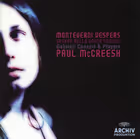
Monteverdi: Vespers, 1610, Gabrieli Consort & Players / Paul McCreesh
- Composer
- Monteverdi
- Artist
- Gabrieli Consort & Players / Paul McCreesh
- Label
- Archiv
- Catalogue
- 477 6147
- Reviewed by
- Anne McAlister
When any performance of Monteverdi’s 1610 Vespers is planned, many questions have to be considered. Is it a single work or a miscellany? Is it for a choir or solo voices? How much should the instruments play? At what pitch should certain movements be played? The CD booklet includes an enlightening conversation with McCreesh in which he outlines his approach: when the Vespers music was published in 1610, Monteverdi was established in Mantua, where he had access to superb musicians; by taking the five psalms, already in their correct liturgical order, and a selection of the other Vespers music, in a different order, and framing the psalms with antiphons or appropriate instrumental substitutes, it is possible to arrive at a plausible liturgical setting of Vespers as it might have taken place in the ducal chapel in Mantua. This leads to an entirely different effect from the theatrical approach adopted by Gardiner with a much bigger choir in St Mark’s, or, at the other extreme, Alessandrini’s intense and dramatic approach with the same number of singers (twelve) as McCreesh.
Although McCreesh’s tempi are generally not far different from Gardiner’s, his singers treat the music in a more intimate, even devotional, fashion. This is not to say the performance isn’t exciting; in parts it is very exciting, but always appropriately within the liturgical setting. The addition of plainchant antiphons creates a more contemplative atmosphere, as does the performance of the Magnificat and Lauda Jerusalem at a pitch a fourth lower than published, an effect especially marked at Et misericordia, where the bass growls at the bottom of his range. The performance generates its own momentum and atmosphere; while after only a few minutes the listener might be wondering why this recording has gathered so many good reviews, by the end of the entrancing Pulchra es duet one has become aware that this recording is something very special.
The two violinists commissioned two early Baroque Italian violins especially for this recording, and their playing is a delight, particularly in the hymn Ave Maris Stella. All the instrumental playing is superb; few performances of the Sonata sopra Sancta Maria can match this one for virtuosity. Again, McCreesh has had a hand in this, as he has deliberately decided to use instruments only where Monteverdi has explicitly written parts for them, leading to much clearer textures. So, the final verdict: for the first time, I have found a recording to rival my old Gardiner one, and I wouldn’t now wish to be without either. I’ll let Paul McCreesh have the last word: “I do feel that our version offers a more satisfying musical, emotional, and even spiritual experience.”
About the performers
Paul McCreesh founded the Gabrieli Consort & Players in 1982, building a reputation for large-scale reconstructions of historical liturgical and ceremonial music, this Vespers recording sits alongside his earlier “Venetian Vespers” project (a related but distinct 1990s reconstruction using music by several composers around Monteverdi’s Venice) as one of the ensemble’s signature undertakings. Recorded in October 2006, this account represents McCreesh’s own dedicated reconstruction of the 1610 publication itself, rather than a generalised evocation of the Venetian liturgical tradition.
A note on this page
Originally published by Anne McAlister, recovered from mmmusic's own archive and reproduced here as the critic wrote it.
Questions about this recording
What performing tradition does McCreesh's recording follow?
McCreesh takes the five psalms (already in their correct liturgical order in Monteverdi's 1610 publication) plus a selection of the other Vespers music, framed with antiphons or instrumental substitutes, to arrive at a plausible reconstruction of how Vespers might have sounded in the ducal chapel at Mantua, where Monteverdi was working when the music was published.
How does this differ from Gardiner's well-known recording?
Gardiner's account uses a much bigger choir performing in St Mark's, Venice, taking a more theatrical approach; McCreesh's twelve singers (matching Alessandrini's forces) bring a more intimate, devotional character, with plainchant antiphons adding a contemplative atmosphere between movements.
What's distinctive about the instrumental playing?
The two violinists commissioned early Baroque Italian violins especially for this recording, and McCreesh restricts instruments to only where Monteverdi explicitly wrote parts for them, producing unusually clear textures throughout.
Is this recording still available to buy?
Yes, Archiv's catalogue number 477 6147 remains findable through classical retailers. We don't run an in-house shop, so we link out to Amazon and Discogs below.


