
CD Review
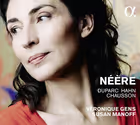
Various: Néère, Véronique Gens, soprano
- Composer
- Various
- Artist
- Véronique Gens, soprano; Susan Manoff, piano
- Label
- Alpha Classics
- Catalogue
- ALPHA 215
Véronique Gens and pianist Susan Manoff’s Néère, released on Alpha Classics in 2015, gathers late-19th-century French mélodies by Henri Duparc, Ernest Chausson and Reynaldo Hahn — a recital built entirely within a single national song tradition rather than spanning multiple eras or languages. It won the 2016 Gramophone Award for Solo Vocal.
About the repertoire
The French mélodie occupies a broadly similar position in French vocal music to the German Lied — a sophisticated art-song tradition built around close attention to text setting and piano-voice interplay — though its specific harmonic and poetic language developed along quite different lines through the work of composers like Duparc, Chausson and later Debussy and Fauré. Duparc’s own song output is famously small, since he destroyed much of his work and stopped composing relatively early in his career, making his surviving mélodies a comparatively concentrated body of material; Chausson and Hahn each contribute a broader, more varied sampling of the same late-Romantic French vocal idiom, giving the recital both depth within Duparc’s narrower catalogue and breadth across his two contemporaries.
About the performers
Véronique Gens has built a substantial part of her recording career specifically around French vocal repertoire, ranging from Baroque opera roles through to the 19th- and early-20th-century mélodie tradition represented here, making this recital a natural extension of a long-standing area of specialism rather than a departure into unfamiliar territory. Pianist Susan Manoff, a recital partner with an extensive career in vocal chamber music specifically, provides the kind of close, text-sensitive collaborative playing the mélodie repertoire depends on — art song of this kind treats the piano as an equal interpretive voice rather than a purely supportive accompaniment, closer in spirit to genuine chamber music than to a soloist-plus-accompanist arrangement.
Why a single-tradition recital works
Programming an entire recital within one national song tradition, across three closely contemporary composers, lets a listener hear the shared harmonic and expressive vocabulary of French fin-de-siècle art song without the more disorienting shifts in style and language a mixed-composer, mixed-tradition recital would introduce. For a singer as closely identified with this specific repertoire as Gens, a recital built this way also functions as a kind of specialist’s statement — a considered, carefully sequenced argument for why Duparc, Chausson and Hahn belong together on one disc, rather than a broader career-spanning survey that samples more widely but more thinly.
Reception
Reviewers responded particularly to the recital’s internal coherence — the decision to stay within one closely related group of French fin-de-siècle composers rather than ranging more widely gave critics a clear basis for judging the album on its own stated terms, rather than as a scattered sampler. Duparc’s notoriously small surviving output, a product of the composer largely abandoning composition and destroying earlier work relatively early in his career, meant that a recital drawing meaningfully on his songs alongside Chausson’s and Hahn’s larger catalogues required genuine curatorial judgment about how to balance a concentrated, hard-to-source body of material against two more expansive contemporaries without either dominating the programme.
A note on this page
This is new writing about a real, current recording, not part of the archive recovered from mmmusic’s original 1991–2018 run. It draws on independently verified facts about the recording, its performers and its reception, extending the same standard of factual reporting to work made well after the shop itself stopped trading.
Questions about this recording
Which composers feature on this recital?
Henri Duparc, Ernest Chausson and Reynaldo Hahn — three composers closely associated with the late-19th-century French mélodie tradition, the French art-song form parallel to the German Lied.
What does the album title Néère refer to?
Néère draws its title from Hahn's own song setting on the disc, using it as the recital's overall title rather than naming the album after any single composer featured.
Did this album win an award?
Yes — the 2016 Gramophone Award for Solo Vocal, recognising the recital against other vocal recordings released that year.
Why is Véronique Gens closely associated with this repertoire?
She has built a substantial part of her recording career around French vocal repertoire specifically, from Baroque opera through to 19th- and early-20th-century mélodie, making a Duparc/Chausson/Hahn recital a natural extension of long-standing specialist territory rather than a one-off departure.
Is this recording still available to buy?
Yes — Alpha Classics's 2015 release remains available through the label and classical retailers. We don't run an in-house shop, so we link out to Amazon and Discogs below.


