CD Review
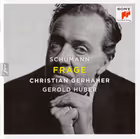
Robert Schumann: Frage, Christian Gerhaher, baritone
- Composer
- Robert Schumann
- Artist
- Christian Gerhaher, baritone; Gerold Huber, piano
- Label
- Sony Classical
- Catalogue
- 19075889192
Christian Gerhaher and Gerold Huber’s Schumann song recital Frage won the Gramophone Solo Vocal Award in 2019 — recognition for a duo whose decades-long working partnership has become one of the defining voice-and-piano relationships in contemporary Lieder performance.
About the programme
Rather than presenting a single complete Schumann song cycle, Frage draws songs from across several of his published sets — the Sechs Gesänge Op. 107, Romanzen und Balladen Op. 49, Drei Gesänge Op. 83, Zwölf Gedichte Op. 35 (settings of Justinus Kerner) and Vier Gesänge Op. 142 — assembling a programme built around thematic and emotional connections between individual songs rather than the architecture of one existing cycle. Schumann’s song-writing is distinctive for how much independent musical material he gives the piano: substantial preludes, harmonically active accompaniment, and postludes that continue developing musical ideas after the singer has finished, effectively making the piano a second voice in dialogue with the first rather than mere support.
About the performers
Baritone Christian Gerhaher and pianist Gerold Huber have performed together since they were students in Munich in the early 1990s, and that history shows directly in how integrated their duo sound is — Huber’s playing is treated throughout as fully equal to Gerhaher’s voice, matching the genuine textual and harmonic partnership Schumann wrote into the songs rather than defaulting to a more conventional accompanist role. Gerhaher has built a career centred substantially on the German Lieder tradition alongside opera and concert work, and this recording sits within a broader Schumann and Schubert song discography the two have built together for Sony Classical over many years.
About the song selection
Rather than working through complete cycles in their published order, Frage curates individual songs across sets written at different points in Schumann’s career, grouped instead around shared emotional or poetic threads — questioning, longing, and the kind of interior uncertainty the album’s title (German for “question”) points toward. This kind of thematic rather than chronological programming is a genuine curatorial choice, requiring real familiarity with the full breadth of Schumann’s song output to select material that coheres as a single listening experience rather than reading as a miscellaneous selection.
About the performers’ interpretive approach
Gerhaher has spoken in interviews about treating Lieder performance as fundamentally a text-driven art, prioritising the meaning and shape of the poetry over pure vocal display — an approach that suits Schumann’s own compositional instincts, since his songs are frequently built around close, responsive setting of the text rather than opportunities for vocal virtuosity. Huber’s playing, shaped by their decades-long partnership, follows the same instinct: rather than a pianist accompanying a singer, the recording captures two musicians who have spent thirty years developing a shared sense of pacing, rubato and dynamic shading specific to this repertoire, a level of integration genuinely difficult for a newly assembled duo to replicate.
A note on this page
This review was written fresh to cover a real, award-winning recording — it’s new coverage rather than part of the archive recovered from mmmusic’s original 1991–2018 run, extending the same standard of factual reporting to what’s being recorded and recognised today.
Questions about this recording
What's on the Frage recital?
A programme of Schumann Lieder drawn from across several published song sets, including the Sechs Gesänge Op. 107, Romanzen und Balladen Op. 49, Drei Gesänge Op. 83, the Zwölf Gedichte Op. 35 and Vier Gesänge Op. 142, rather than a single complete cycle.
Why is the piano treated as an equal partner rather than accompaniment?
Schumann's song-writing is known for giving the piano genuinely independent musical material — melodic lines, harmonic commentary and extended postludes that continue after the voice has finished — and Gerhaher and Huber's long working partnership is built around treating the two parts as a true duo rather than voice-with-accompanist.
How long have Gerhaher and Huber worked together?
Since their student days together in Munich in the early 1990s, making this one of the longest-running and most closely integrated song-recital partnerships in contemporary classical performance.
Is this recording still available to buy?
Yes — Sony Classical's catalogue number 19075889192 remains available through the label and classical retailers. We don't run an in-house shop, so we link out to Amazon and Discogs below.


