CD Review
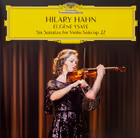
Eugène Ysaÿe: Six Sonatas for Solo Violin, Op. 27, Hilary Hahn, violin
- Composer
- Eugène Ysaÿe
- Artist
- Hilary Hahn, violin
- Label
- Deutsche Grammophon
- Catalogue
- 486 4177
Eugène Ysaÿe’s Six Sonatas for Solo Violin, Op. 27, sit among the most demanding works ever written for unaccompanied violin, six substantial, technically punishing pieces with nowhere for a player to hide. Hilary Hahn’s 2023 recording for Deutsche Grammophon took both the Instrumental Award and the overall Recording of the Year at the 2024 Gramophone Classical Music Awards, the magazine’s top honour, awarded to a single recording chosen from the full field of classical releases submitted that year.
Ysaÿe wrote the sonatas in 1923, by which point he was already recognised as one of the defining violin virtuosos of the late nineteenth and early twentieth centuries, a player whose own performing style helped shape how the instrument was taught and heard well into the following generation. The story usually told is that he was struck by hearing the Hungarian violinist Joseph Szigeti perform Bach’s unaccompanied sonatas and partitas, and set out to write a twentieth-century answer to them: works that could stand alongside Bach’s as a serious unaccompanied cycle, but written in a harmonic and technical language shaped by the violin playing of Ysaÿe’s own era rather than the Baroque.
Six sonatas, six real dedicatees
Each of the six sonatas carries a dedication to a specific violinist Ysaÿe knew and admired, and each is written, at least in spirit, with that player’s own musical personality in mind. The First is dedicated to Szigeti, whose Bach playing had prompted the whole project. The others went to Jacques Thibaud, George Enescu, Fritz Kreisler, Mathieu Crickboom and Manuel Quiroga, a genuine cross-section of the leading violinists working in Europe in the 1910s and 1920s. Knowing this gives the cycle a different character to Bach’s: rather than one composer’s single sustained statement, it reads more like six individual portraits, each written for a real person Ysaÿe expected to eventually perform it.
Musically, the sonatas range from the severe, contrapuntally dense First, the most obviously Bach-indebted of the six, through the Second, which quotes the Dies irae plainchant repeatedly and carries an unmistakable sense of unease, to the folk-inflected Fifth and the flamboyant, Spanish-tinged Sixth written for Quiroga. Playing all six in sequence, as a single unaccompanied recital, asks a violinist to sustain both the raw technical demands and a real sense of six distinct musical voices across well over an hour of music with no accompaniment to lean on.
About the performer
Hilary Hahn has built one of the most recognised careers among violinists of her generation, with a catalogue of recordings ranging from Bach’s own unaccompanied sonatas and partitas to newly commissioned concertos. Her Ysaÿe recording followed a period in which she had spoken publicly about stepping back from performing to protect against burnout, a context that makes a return to some of the most technically and interpretively demanding solo repertoire in the violin literature a genuinely notable choice, rather than a routine addition to an existing discography.
It’s also worth noting this isn’t the only recent high-profile account of the cycle: James Ehnes recorded the same six sonatas for Onyx Classics in 2021, itself a Gramophone Instrumental Award winner in 2022. Two major violinists producing acclaimed, differently characterised recordings of the same unaccompanied cycle within a few years of each other says something about how central this music has become to the modern violin repertoire, more than a century after it was written for players most listeners today have never heard perform.
A note on this page
This review was written fresh, for a real recording currently receiving genuine critical attention. It isn’t part of the archive of pages recovered from mmmusic’s original 1991–2018 run as a shop. We’re extending the same kind of factual, non-sensational coverage to what’s actually being recorded and awarded today, verified against real sources rather than reconstructed from memory or guesswork.
Questions about this recording
Why did Ysaÿe write six unaccompanied violin sonatas?
Eugène Ysaÿe, himself one of the great violin virtuosos of his generation, wrote the Op. 27 sonatas in 1923, reportedly inspired by hearing Joseph Szigeti perform Bach's solo violin works. Each of the six sonatas is dedicated to a different violinist Ysaÿe knew personally and modelled, at least loosely, on that player's own musical character.
Who are the six sonatas dedicated to?
Joseph Szigeti, Jacques Thibaud, George Enescu, Fritz Kreisler, Mathieu Crickboom and Manuel Quiroga, six real violinists working in the 1910s and 1920s, each a significant figure in their own right.
What did this recording win?
Hilary Hahn's recording won both the Instrumental Award and the overall Recording of the Year at the 2024 Gramophone Classical Music Awards, the magazine's single top prize, chosen from every classical release submitted that year.
Has anyone else recorded this cycle recently?
Yes, James Ehnes recorded the same six sonatas for Onyx Classics, released in 2021 and itself a Gramophone Instrumental Award winner in 2022. Comparing the two is a useful way to hear how differently two major violinists can approach the same unaccompanied cycle.


