CD Review
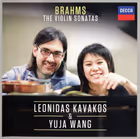
Brahms: The Violin Sonatas, Leonidas Kavakos, violin
- Composer
- Brahms
- Artist
- Leonidas Kavakos, violin; Yuja Wang, piano
- Label
- Decca
- Catalogue
- 478 6442
Leonidas Kavakos and Yuja Wang’s 2014 Decca recording of Brahms’s complete violin sonatas grew directly out of their performances together at the Verbier Festival the year before, a pairing of two soloists more usually heard leading their own separate careers than working as a settled chamber-music duo. It was Kavakos’s third release for Decca, recorded at the Friedrich-Ebert-Halle in Hamburg, and arrived in the same year Kavakos was voted Gramophone’s Artist of the Year, a public-vote award decided independently of any single recording rather than a prize for this disc specifically. Gramophone’s own review praised the two as giving “consistently outstanding performances.”
About the programme
The three numbered sonatas, Op. 78 in G major, Op. 100 in A major, and Op. 108 in D minor, represent Brahms across roughly a decade of his maturity, from the lyrical, pastoral G major sonata of 1878–79 through to the more dramatically weighted D minor sonata of 1886–88, his last major work in the genre. Recording all three together as a complete cycle, rather than pairing individual sonatas with other composers’ music, lets a listener track Brahms’s own evolution within a single closely related form. The disc also includes his contribution to the “F-A-E” Sonata, a collaborative piece written jointly with Robert Schumann and Albert Dietrich in 1853 as a gift for the violinist Joseph Joachim, built around a musical motif spelling out Joachim’s personal motto, and a violin-and-piano arrangement of Brahms’s own famous “Wiegenlied” lullaby, giving the disc a lighter closing note after three substantial sonatas.
About the performers
Leonidas Kavakos, a Greek violinist with an already substantial international reputation by 2014, brought a level of institutional standing to this recording that the same year’s Gramophone Artist of the Year vote reflected independently of the disc itself. Yuja Wang, the Chinese-born pianist known equally for her interpretive range and her prominence as a soloist in her own right, here takes on the genuinely equal chamber-music role Brahms’s sonatas demand, these are not violin-with-piano-accompaniment works but genuine duo sonatas, and pairing two performers each more typically heard as featured soloists tests exactly that balance.
Why this pairing works
Brahms wrote his violin sonatas late enough in his career that the piano part is never merely supportive, both the G major and D minor sonatas open with material stated as much in the keyboard as in the violin, and the writing regularly hands the more prominent melodic line to the piano for whole passages. A pianist better known as a concerto soloist, playing alongside a violinist of comparable stature, is in some ways closer to what the scores actually ask for than a more conventionally balanced “violinist plus accompanist” duo, even if the commercial framing of two star names recording together inevitably reads, on the surface, as a crossover pairing rather than a natural fit for the material.
A note on this page
This is new writing about a real, current recording, not part of the archive recovered from mmmusic’s original 1991–2018 run. It’s fresh coverage built from independently verified facts about the recording, its performers and its reception, extending the same standard of factual reporting to a release made after the shop itself stopped operating.
Questions about this recording
What's on this recording?
Brahms's complete cycle of violin sonatas, No. 1 in G major (Op. 78), No. 2 in A major (Op. 100), and No. 3 in D minor (Op. 108), plus his Scherzo from the collaborative "F-A-E" Sonata (WoO 2) and an arrangement of the song "Wiegenlied" (Op. 49, No. 4).
What's the "F-A-E" Sonata?
A joint composition by Brahms, Robert Schumann and Albert Dietrich, written in 1853 as a gift for violinist Joseph Joachim, built around the musical motif F-A-E (standing for Joachim's motto "Frei aber einsam", "free but lonely"). Only Brahms's Scherzo movement from it is included here.
How did this pairing come about?
Kavakos and Wang's partnership grew out of performances at the 2013 Verbier Festival, which led directly to this studio recording the following year.
Is this recording labelled Decca or Sony?
Decca, this was Kavakos's third release for the label, released in 2014.
Is this recording still available to buy?
Yes, Decca's catalogue number 478 6442 remains findable through classical retailers. We don't run an in-house shop, so we link out to Amazon and Discogs below.


