CD Review
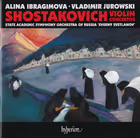
Dmitri Shostakovich: Violin Concertos Nos. 1 & 2
- Composer
- Dmitri Shostakovich
- Artist
- Alina Ibragimova, violin; State Academic Symphony Orchestra of Russia 'Evgeny Svetlanov' / Vladimir Jurowski
- Label
- Hyperion
- Catalogue
- CDA68313
Alina Ibragimova’s Hyperion recording of both Shostakovich violin concertos, with Vladimir Jurowski conducting the State Academic Symphony Orchestra of Russia “Evgeny Svetlanov,” won the Gramophone Concerto Award in 2021 — recognition for a violinist whose recording career has leaned deliberately toward exactly this kind of unflinching, historically loaded repertoire rather than safer crowd-pleasers.
About the concertos
The First Violin Concerto (Op. 77) was composed in 1947-48, during one of the most dangerous periods of Shostakovich’s career — his music had recently been formally denounced by the Soviet cultural authorities, and the concerto’s scale and seriousness made it politically risky to perform. It sat unheard until 1955, after Stalin’s death, when its dedicatee David Oistrakh gave the premiere. The Second Violin Concerto (Op. 129), written in 1967 for Oistrakh’s 60th birthday, is a very different piece: shorter, sparer, and more withdrawn, written by a composer by then in declining health and working in a more compressed, interior idiom. Programming both together, rather than pairing one with a different composer’s concerto, turns the disc into a study of exactly how much distance Shostakovich covered as a composer across two decades under the same political system.
About the performers
Ibragimova has built a recording career notable for its range — moving between Bach’s solo violin works, Mozart concertos on period instruments, and 20th-century repertoire including Shostakovich, Prokofiev and Weinberg — without settling into a single specialist niche. Vladimir Jurowski, a Russian-born conductor who has held major posts in the UK and Germany, brings a close familiarity with Soviet-era orchestral repertoire to the podium, leading an orchestra — founded as the USSR State Symphony Orchestra and long associated with Evgeny Svetlanov — with its own direct institutional lineage back to the world these concertos were written in.
Why the pairing matters
Listening to the two concertos back to back makes the gap between them audible in a way that hearing either alone doesn’t. The First Concerto follows a four-movement plan closer to a symphony than a conventional showpiece concerto, opening with a brooding Nocturne rather than a bravura first movement, and building to an enormous cadenza that leads directly into a driven, almost aggressive finale — writing shadowed throughout by the political danger Shostakovich was working under. The Second Concerto, written when Oistrakh turned 60 and Shostakovich’s own health was already declining, strips much of that grandeur away: it’s shorter, more transparent in its orchestration, and more ambiguous in tone, closer in spirit to the composer’s late string quartets than to a conventional virtuoso vehicle. Reviewers responding to this recording singled out Ibragimova’s refusal to over-project either work — playing the First with its dark humour intact rather than pure heroism, and the Second with real restraint rather than pushing for easy virtuoso payoff.
About the orchestra
The State Academic Symphony Orchestra of Russia, long associated with the conductor Evgeny Svetlanov (whose name it still carries), traces its own institutional history back to the Soviet-era USSR State Symphony Orchestra — meaning the ensemble playing here has a direct lineage into the same musical culture that originally produced these concertos, distinct from a Western orchestra approaching this repertoire from the outside. That historical proximity gives the recording an added layer of authenticity beyond just the soloist’s own advocacy for the music.
A note on this page
This review was written fresh to cover a real, award-winning recording — it’s new coverage rather than part of the archive recovered from mmmusic’s original 1991–2018 run, extending the same standard of factual reporting to what’s being recorded and recognised today.
Questions about this recording
Why pair both Shostakovich violin concertos on one disc?
The two works were written two decades apart — No. 1 in 1947-48, held back from performance until after Stalin's death, and No. 2 in 1967 — and hearing them together lets a listener track how far Shostakovich's musical language shifted across that gap, from a large-scale, formally weighty First Concerto to the sparer, more interior Second.
Why was the First Violin Concerto held back for years?
It was completed in 1947-48 during a period of official Soviet cultural crackdown, when Shostakovich's music had already been denounced; the concerto wasn't premiered until 1955, after Stalin's death, by its dedicatee David Oistrakh.
Who is Alina Ibragimova?
A Russian-born, UK-based violinist known for pairing mainstream and Soviet-era repertoire with historically informed and contemporary projects alike, recording extensively for Hyperion across concerto and chamber repertoire.
Is this recording still available to buy?
Yes — Hyperion's catalogue number CDA68313 remains available through the label and classical retailers. We don't run an in-house shop, so we link out to Amazon and Discogs below.


