CD Review
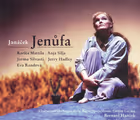
Janáček: Jenůfa
- Composer
- Janáček
- Artist
- Karita Mattila, Anja Silja, Jorma Silvasti, Jerry Hadley; Chorus & Orchestra of the Royal Opera House, Covent Garden / Bernard Haitink
- Label
- Erato
- Catalogue
- 0927-45330-2
- Reviewed by
- Sandy Matheson
Although Jenůfa (or Její pastorkyňa, Her Foster-Daughter, to give it its Czech title) was the first of Janáček’s operas to gain an international reputation, until comparatively recently it was performed in an “edition” which significantly departed from the composer’s intentions. The version of Jenůfa familiar to several generations of opera-lovers was prepared by the then music director of the National Theatre of Prague, Karel Kovarovic. Entirely without the composer’s permission, Kovarovic made numerous cuts, altered the orchestration to bring it closer to the sound world of Richard Strauss and scrapped Janáček’s equivocal ending in favour of a grand peroration. Regrettably, Universal Edition of Vienna published Kovarovic’s version without any editorial comment; in this fashion it became the standard text. Somewhat belatedly, Universal published a de-Kovaroviched edition, edited by John Tyrrell and Sir Charles Mackerras, in 1998; Bernard Haitink has used it as the basis for his much-praised performances at the Royal Opera House last year. Mackerras’s own recording, made for Decca in 1982, also reverts to Janáček’s score as he left it in his final revision; it remains Haitink’s only serious rival on CD. On the new set, the central characters, Jenůfa herself and the Kostelnička, her stepmother, are sung by Karita Mattila and Anja Silja respectively. Mattila is in glorious voice; arguably she’s even better than Elisabeth Söderström (for Mackerras) on account of her more youthful image. Silja, nearing the end of a highly distinguished career was by all accounts an electrifying presence on stage. On CD, her voice sounds dangerously frayed at times, but not inappropriately so; after all, she is portraying a woman who murders her step-daughter’s baby. Between them, Mattila and Silja generate an almost unbearable tension in the closing pages of Act II. Jorma Silvasti, a name new to me, sings strongly and portrays the various aspects of Laca’s character convincingly; Jerry Hadley, as the rather stereotypical rich bounder Steva, is no match for Petr Dvorský on the Mackerras set. Haitink’s approach is gentler, paler?, than Sir Charles’s intense view, an impression reinforced by the recorded sound, which favours the voices, rather muting the orchestra. Haitink catches the sense of an uncertain future for Jenůfa and Laca at the end, drawing eloquent playing from the orchestra. In Act II, it is Sir Charles who more powerfully captures the sense of impending dread, the intrusion of the storm at the close of that Act is terrifying in his hands. For a “library choice”, I’d still go for the superb Mackerras version, although do try Mattila and Silja, they make a fearsome double-act, while Haitink offers a dignified and compassionate view of Janáček’s first operatic masterpiece.
A note on this page
Originally published by Sandy Matheson, recovered from mmmusic's own archive and reproduced here as the critic wrote it.
Questions about this recording
Why did this recording need a corrected edition?
For decades Jenůfa was performed in an edition altered without Janáček's permission by Karel Kovarovic, who cut and reorchestrated the score and changed its ending; a de-Kovaroviched edition by John Tyrrell and Sir Charles Mackerras only appeared in 1998.
Who sings the central roles?
Karita Mattila sings Jenůfa and Anja Silja sings her stepmother the Kostelnička; Jorma Silvasti sings Laca and Jerry Hadley sings Steva.
How does Haitink's recording compare to Mackerras's?
The review calls Haitink's approach gentler and paler than Mackerras's more intense reading, with recorded sound favouring the voices over the orchestra, but still names the older Mackerras set as its 'library choice' overall.
Is this recording still available to buy?
Yes, Erato's catalogue number 0927-45330-2 remains findable through classical retailers. We don't run an in-house shop, so we link out to Amazon and Discogs below.


