CD Review
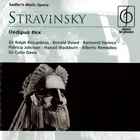
Stravinsky: Oedipus Rex, Dowd
- Composer
- Stravinsky
- Artist
- Dowd; Johnson; Herincx; Sadler's Wells Opera Chorus; Royal Philharmonic Orchestra / Davis
- Label
- Classics For Pleasure
- Catalogue
- CFP 585 0112
- Reviewed by
- Sandy Matheson
The pick of CFP’s Sadler’s Wells reissues, this marvellous Oedipus Rex has been languishing in the vaults for far too long, indeed, I confess that I had no idea of its existence. Despite the early indifference of audiences and the ungrateful reaction of its dedicatee, Sergey Diaghilev, he called it “un cadeau macabre”, Oedipus Rex has proved to be one of Stravinsky’s most enduring masterpieces.
Sir Colin Davis’s 1984 recording with Thomas Moser and Jessye Norman is well known and remains highly recommendable. Davis’s headlong approach is if anything even more pronounced with the Sadler’s Wells forces; the last five minutes is a ride to the abyss. Ronald Dowd, in the title rôle, has a heftier voice than the piece ideally demands; however, he shows more concern for what Stravinsky actually wrote than many practitioners of this part seem to do. Patricia Johnson, the Jocasta, is a fire-eating Verdian mezzo; “Oracula, oracula” seems to come up from the soles of her feet.
A sign of the strength of this company in the early 1960s is that Alberto Remedios was on hand to take the small but important part of the Shepherd. The Sadler’s Wells chorus combines accuracy with the heart-and-soul commitment usually only found in amateur choirs. Ralph Richardson reprises his well-known persona of a public school head-master. It’s good to have him; I must say that I prefer the narration in French, just because lines like “Il tombe! Il tombe de haut!” sound so cool! Very highly recommended.
About the work’s origins
Stravinsky and Jean Cocteau conceived Oedipus Rex, Latin text after Sophocles, with Cocteau’s French narration threaded between the sung numbers, specifically as a gift for Diaghilev, marking the twentieth anniversary of his work as an impresario. Diaghilev, informed of the plan only once the piece was already meant for his company, wasn’t especially pleased with it, and settled on presenting the 1927 Paris premiere as a bare concert performance rather than a staged one, the singers simply in evening dress against black velvet curtains, with no set at all. That semi-staged, oratorio-like format has stuck ever since, which is part of why a purely audio recording like this one loses comparatively little of the original conception compared with most stage works.
A note on this page
Originally published by Sandy Matheson, recovered from mmmusic's own archive and reproduced here as the critic wrote it.
Questions about this recording
Why was this recording overlooked for so long?
The review describes it as having languished unnoticed in Classics For Pleasure's Sadler's Wells reissue vaults, despite being, in the reviewer's judgement, the pick of that whole reissue series.
How does this recording compare to Colin Davis's better-known 1984 account?
Davis's 1984 recording with Thomas Moser and Jessye Norman remains well known and recommendable, but his earlier Sadler's Wells account here is even more headlong in approach, especially in its final five minutes.
Who narrates the spoken text?
Ralph Richardson, reprising his familiar public-school-headmaster persona, the review notes a preference for the narration in French over English.
Is this recording still available to buy?
Yes, Classics For Pleasure's catalogue number CFP 585 0112 remains findable through classical retailers. We don't run an in-house shop, so we link out to Amazon and Discogs below.


