CD Review
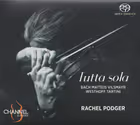
Various composers: Tutta Sola, Rachel Podger, violin
- Composer
- Various (Bach, Matteis, Vilsmayr, Westhoff, Tartini)
- Artist
- Rachel Podger, violin
- Label
- Channel Classics
- Catalogue
- CCSSA44422
Rachel Podger’s Tutta Sola took both of BBC Music Magazine’s top prizes at its 2023 awards, Recording of the Year, decided by public vote from a shortlist of three finalists, and the Instrumental Award, decided separately by a panel of critics and musicians. Winning by two different routes in the same year, for the same disc, is a fairly unusual double. The programme is entirely unaccompanied violin: Podger alone, moving across roughly a century and a half of repertoire written for solo violin without any other instrument, from Nicola Matteis through to J.S. Bach.
About the programme
Tutta Sola is built with a specific historical argument in mind: rather than presenting Bach’s Sonatas and Partitas for solo violin in isolation, as most unaccompanied-violin recitals do, Podger surrounds them with the lesser-known composers whose own unaccompanied violin writing likely fed into Bach’s. The programme includes movements from Johann Paul von Westhoff’s suites, Johann Joseph Vilsmayr’s Suite for solo violin without bass, and Giuseppe Tartini’s Piccola Sonata, alongside Bach himself, represented here not by the familiar Sonatas and Partitas directly, but by a solo-violin arrangement of the Toccata and Fugue in D minor, BWV 565, a work far more commonly heard on organ. Framing that arrangement as an opening statement, rather than closing on more expected unaccompanied-Bach territory, sets the disc’s intent early: this is a recital about the tradition Bach worked within, not just Bach in isolation.
Nicola Matteis, an Italian violinist-composer who settled in London in the 1670s, is a useful hinge figure for the programme’s argument: his own published collections of unaccompanied and lightly accompanied violin music were influential on the wider European violin tradition decades before Bach wrote a note of his Sonatas and Partitas. Johann Joseph Vilsmayr and Johann Paul von Westhoff both worked in the German-speaking lands in the generation just before Bach, Westhoff in particular is now recognised as having written some of the earliest known unaccompanied violin suites anywhere, predating Bach’s own by roughly two decades, while Giuseppe Tartini, born a generation after Bach, represents the tradition continuing to develop in Italy on a separate but related track. Hearing all of them on a single disc, in roughly chronological sequence, makes an audible case for a shared unaccompanied-violin lineage rather than treating Bach’s contribution as an isolated peak.
About the performer
Rachel Podger is a British violinist specialising in Baroque and Classical-era repertoire on period instruments, long associated with historically informed performance in the UK and internationally. She has recorded extensively for Channel Classics across a substantial discography spanning Bach, Vivaldi, Biber and other Baroque repertoire, and her academic-adjacent, source-driven approach to programme-building, tracing a piece’s context rather than presenting it as a standalone showpiece, is a consistent thread across her recordings, of which Tutta Sola’s historical framing is a clear example.
A note on this page
This review was written fresh, from independently verified facts about the recording and its 2023 BBC Music Magazine awards, rather than recovered from mmmusic’s original 1991–2018 archive. The shop had already closed by the time this disc was released. It’s part of the site’s ongoing coverage of new classical releases, alongside the reviews recovered from the original site’s run.
Questions about this recording
What did Tutta Sola win?
Both the BBC Music Magazine Recording of the Year Award and the Instrumental Award for 2023, announced at a ceremony at Kings Place in London. Recording of the Year was decided by public vote from a shortlist of three; the Instrumental Award, by a panel of critics and musicians.
What's the programme built around?
Unaccompanied violin works by Bach, Matteis, Vilsmayr, Westhoff and Tartini, opening with a solo-violin arrangement of Bach's Toccata and Fugue in D minor, BWV 565, a work usually heard on organ. The programme is deliberately built to trace the earlier composers whose unaccompanied violin writing fed into Bach's own Sonatas and Partitas.
Why 'Tutta Sola', 'all alone'?
The Italian phrase describes the recital's format directly: one violinist, entirely unaccompanied, for the whole programme, across roughly a century and a half of repertoire for solo violin without any other instrument.
Is this recording still available to buy?
Yes, Channel Classics' catalogue number CCSSA44422 remains available through the label and classical retailers. We don't run an in-house shop, so we link out to Amazon and Discogs below.


