
CD Review
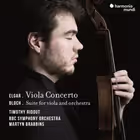
Elgar / Bloch: Viola Concerto (arr. Tertis) / Bloch: Suite for Viola and Orchestra
- Composer
- Elgar / Bloch
- Artist
- Timothy Ridout, viola; BBC Symphony Orchestra / Martyn Brabbins
- Label
- Harmonia Mundi
Elgar never wrote a concerto for viola. What Timothy Ridout plays here is Lionel Tertis’s own arrangement of Elgar’s Cello Concerto in E minor, a recognised, long-standing alternative version of the piece rather than a curiosity, made by the violist most responsible for establishing the viola as a serious solo instrument in the first place. Paired with Ernest Bloch’s Suite for Viola and Orchestra, an original work rather than another transcription, the disc won the Concerto Award at the 2023 Gramophone Classical Music Awards.
About the Tertis arrangement
Lionel Tertis (1876–1975) spent much of his career persuading composers to write seriously for an instrument that, before him, had little dedicated solo repertoire of real substance. Where composers wouldn’t oblige, he made his own transcriptions of major cello and violin works, and his version of Elgar’s Cello Concerto is among the best known. The concerto itself, written in 1919, in the aftermath of the First World War, and one of Elgar’s last major works, carries an elegiac quality that transfers naturally to the viola’s darker, more covered tone, even though the piece was conceived for cello’s greater projection and range. Hearing it on viola changes the balance between soloist and orchestra in ways a listener familiar with the standard cello version will notice immediately, without the arrangement doing violence to Elgar’s actual musical material.
About the Bloch Suite
Ernest Bloch’s Suite for Viola and Orchestra, completed in 1919 in the United States, was written as an original concert work for the instrument rather than adapted from anything else, a rarer thing in the viola repertoire than it should be. Its inclusion alongside the Elgar arrangement gives the disc a useful contrast: one substantial work genuinely conceived for viola from the start, sitting next to one of the instrument’s most celebrated borrowed masterpieces.
About the performer
Timothy Ridout, born in London in 1995, is unusual among professional violists in never having started on violin first, he began as a singer before taking up viola at school. He was a BBC New Generation Artist from 2019 to 2022, won the Borletti-Buitoni Trust Fellowship in 2020 and the Royal Philharmonic Society’s Young Artist Award in 2023, and took first prize at both the Lionel Tertis and Cecil Aronowitz International Viola Competitions, the former named for the very arranger whose version of the Elgar he plays here. The BBC Symphony Orchestra under Martyn Brabbins provides the orchestral partner for both works.
About Bloch’s Suite
Ernest Bloch (1880–1959) was Swiss-born but spent much of his career in the United States, becoming an American citizen in 1924 and serving as the first director of the Cleveland Institute of Music before completing this Suite in 1919. His music from this period is often associated with an explicitly Jewish musical identity, heard more directly in earlier works like Schelomo, though the Suite for Viola and Orchestra sits closer to a broader post-Romantic idiom, with a more overt exoticism in its outer movements than the specifically liturgical or folk-derived material of some of his other viola and cello writing. Its comparative neglect next to more famous viola works makes its inclusion here, alongside a piece as well known as the Elgar arrangement, a useful bit of advocacy on Ridout’s part as well as a straightforward artistic pairing.
A note on this page
This review was written fresh by the mmmusic team about a real, current recording, not reproduced from an original mmmusic critic, it’s new coverage rather than part of the site’s recovered 1991–2018 archive. The Tertis arrangement’s history, Bloch’s original authorship of the paired work, and Ridout’s own biography were each checked independently rather than assumed.
Questions about this recording
Did Elgar actually write a viola concerto?
No. This is violist Lionel Tertis's own arrangement of Elgar's Cello Concerto in E minor, Op. 85, transposed and adapted for viola, a recognised alternative version of the piece, not a separate original Elgar work.
Who was Lionel Tertis?
A British violist (1876–1975) widely credited with establishing the viola as a serious solo instrument in the early 20th century, and the arranger of several major cello and violin works for viola, including this Elgar transcription.
What's paired with the Elgar on this disc?
Ernest Bloch's Suite for Viola and Orchestra, B.41, a substantial original viola-and-orchestra work in its own right rather than another arrangement.
Did this recording win an award?
Yes, it won the Concerto Award at the 2023 Gramophone Classical Music Awards.


