CD Review
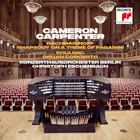
Sergei Rachmaninov / Francis Poulenc: Rhapsody on a Theme of Paganini (arr. organ); Organ Concerto
- Composer
- Sergei Rachmaninov / Francis Poulenc
- Artist
- Cameron Carpenter, organ; Konzerthausorchester Berlin / Christoph Eschenbach
- Label
- Sony Classical
- Catalogue
- 88985390822
Cameron Carpenter’s Sony Classical recording with the Konzerthausorchester Berlin under Christoph Eschenbach pairs Sergei Rachmaninov’s Rhapsody on a Theme of Paganini — arranged by Carpenter himself for organ, since Rachmaninov never wrote for the instrument — with Francis Poulenc’s genuine Organ Concerto, a real and long-established part of the organ-and-orchestra repertoire. Made during Carpenter’s 2017/18 residency at the Konzerthaus Berlin and released in 2019, the recording won Opus Klassik’s Concert Recording of the Year in the organ category in 2020.
About the programme
The Paganini Rhapsody is one of Rachmaninov’s most frequently performed works, built as a set of variations on Paganini’s 24th Caprice for solo violin, originally scored for piano and orchestra with the piano carrying virtuosic material clearly conceived for that specific instrument’s technique. Carpenter’s own transcription of the solo part for organ is, by its nature, an interpretive act as much as a technical one — organ and piano differ fundamentally in how they produce and sustain sound, so an effective transcription has to solve problems the original composer never had to consider. Pairing it with Poulenc’s Organ Concerto, a work genuinely conceived for the instrument from the outset, lets a listener hear the difference directly: one piece adapted to the organ’s specific capabilities, the other built around them from the first note.
About the performers
Cameron Carpenter has built a career as one of the most visible and deliberately unconventional organists working today, known for a performance style — and, at points, custom-built touring instruments — that pushes against the more austere, church-associated image the organ often carries in concert life; a self-arranged Rachmaninov transcription fits squarely within that same impulse toward expanding what the instrument is understood to be capable of. Christoph Eschenbach, a conductor with an extensive career spanning both the concert and opera repertoire, and the Konzerthausorchester Berlin provide the orchestral half of the recording, giving Carpenter’s soloist role the kind of large-scale symphonic partner more usually associated with piano or violin concerto recordings than organ ones.
Why the pairing works
Organ-and-orchestra recordings are comparatively rare in the commercial catalogue relative to piano or violin concerto recordings, in part because the practicalities of touring or recording with a large pipe organ are considerably more constrained than for a portable solo instrument — an organ recording is tied to whichever venue’s instrument is being used, in this case the Konzerthaus Berlin’s own. Presenting a well-known repertoire staple in an unfamiliar organ arrangement alongside a genuine, if less frequently recorded, organ concerto gives the disc a coherent through-line around the instrument itself, rather than simply pairing two unrelated large-scale works — an approach that rewards a listener already curious about what the organ can do outside its traditional liturgical context.
Reception
Opus Klassik, established in 2018 as Germany’s leading classical recording award following the retirement of the earlier Echo Klassik prize, recognised the disc in its dedicated organ category — itself an acknowledgement that organ recordings occupy a distinct enough niche within the classical catalogue to merit separate consideration from piano, violin or orchestral releases. Critical response to Carpenter’s Rachmaninov transcription specifically tended to focus on how convincingly the arrangement solved the problem of translating idiomatically pianistic material onto an instrument with a fundamentally different relationship to touch, sustain and dynamic shading — a technical challenge distinct from simply playing the notes accurately, and one that separates a genuinely successful transcription from a merely serviceable one.
A note on this page
This is new writing about a real, current recording, not part of the archive recovered from mmmusic’s original 1991–2018 run. It draws on independently verified facts about the recording, its performers and its reception, extending the same standard of factual reporting to work made well after the shop itself stopped trading.
Questions about this recording
Did Rachmaninov write for organ?
No — the Rhapsody on a Theme of Paganini was written for piano and orchestra. This recording uses Cameron Carpenter's own arrangement of the piano part for organ, played against the original orchestration.
What's genuinely written for organ on this disc?
Francis Poulenc's Organ Concerto, scored for organ, strings and timpani, is a real part of the standard organ-and-orchestra repertoire, giving the disc one arranged and one authentic organ concerto.
Where and when was this recorded?
During Cameron Carpenter's 2017/18 residency at the Konzerthaus Berlin, with the Konzerthausorchester Berlin under Christoph Eschenbach, released on Sony Classical in 2019.
What else is on the album?
A bonus track drawn from Louis Vierne's Organ Symphony No. 1, recorded as an encore during the same Konzerthaus Berlin engagement.
Did this recording win an award?
Yes — it won Opus Klassik's Concert Recording of the Year (Organ category) in 2020, one of Germany's leading classical music awards.


