
CD Review
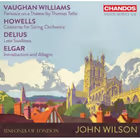
Vaughan Williams, Howells, Delius, Elgar: Music for Strings
- Composer
- Vaughan Williams, Howells, Delius, Elgar
- Artist
- Sinfonia of London, John Wilson
- Label
- Chandos
- Catalogue
- CHSA 5291
English string-orchestra repertoire is a small, well-worn shelf, Elgar’s Introduction and Allegro and Vaughan Williams’s Tallis Fantasia in particular have been recorded dozens of times, by orchestras with a much longer institutional claim on the repertoire than a chamber ensemble revived in 2018. That John Wilson’s Sinfonia of London took both the Orchestral Award and the overall Recording of the Year at the 2024 BBC Music Magazine Awards for exactly this repertoire says less about novelty and more about the standard of the actual playing and the recorded sound Chandos captured, this is a Hybrid SACD release, mixed for multichannel as well as stereo, aimed squarely at listeners who care about the difference.
About the programme
The four works pull from different corners of the same English pastoral-to-elegiac tradition: Vaughan Williams’s 1910 Fantasia on a Theme by Thomas Tallis, built from a 16th-century psalm tune and scored for a double string orchestra plus solo quartet; Herbert Howells’s 1938 Concerto for String Orchestra, a less frequently programmed work than the Vaughan Williams or Elgar pieces here; Delius’s Late Swallows, originally the slow movement of his String Quartet before being arranged for full string orchestra; and Elgar’s 1905 Introduction and Allegro, written to showcase the newly formed London Symphony Orchestra’s string section and still one of the most technically demanding pieces in the string-orchestra repertoire. Together they trace roughly three decades of English string writing, from Elgar’s Edwardian confidence through Vaughan Williams’s modal, Tudor-inflected voice to Howells’s more harmonically restless, less frequently heard concerto.
About the performers
Sinfonia of London’s name has a history stretching back to a mid-20th-century London session orchestra used extensively for film recording, but the ensemble performing on this disc is a distinct 2018 revival, assembled by the conductor John Wilson specifically as a recording orchestra drawing on some of Britain’s most in-demand freelance players. Wilson built his early reputation reconstructing and conducting golden-age film and stage scores before turning that same attention to detail toward core orchestral repertoire, and the Sinfonia of London partnership with Chandos has produced a run of award-recognised recordings, this English string programme among them, built around a distinctively rich, closely blended string sound.
Why the recorded sound matters here
Chandos, the British label behind this release, has built a decades-long reputation specifically around detailed, spacious orchestral recording, and this disc is issued as a Hybrid SACD, a format that carries both a standard CD layer, playable on any CD player, and a higher-resolution Super Audio CD layer, including a multichannel surround mix, for listeners with the equipment to play it. A string-orchestra recording is a particularly demanding test of that kind of engineering: with no wind, brass or percussion to separate out, the entire sound depends on capturing the blend and depth of a large body of string players cleanly, without the sections smearing into an undifferentiated wash, exactly the kind of detail an SACD’s wider frequency range and dynamic headroom is designed to preserve.
Wilson’s own route into this repertoire is worth noting: he first built his conducting reputation on meticulous reconstructions of golden-age Hollywood and Broadway film and stage scores, work that demanded exactly the kind of close attention to orchestral balance and period performing style that this English string programme also rewards. That background, rather than a conventional career built solely through the standard European conducting-competition and opera-house route, is part of why Wilson and the Sinfonia of London’s recordings are often singled out for a particular clarity and warmth of orchestral sound rather than for interpretive novelty alone.
A note on this page
This review was written fresh for mmmusic, covering a real, current recording rather than reproducing any page from the site’s 1991–2018 archive, the shop had already closed by the time this disc was released. Facts here (programme, personnel, award history) have been independently verified rather than assumed.
Questions about this recording
What's actually on this recording?
Four English works for string orchestra: Vaughan Williams's Fantasia on a Theme by Thomas Tallis, Herbert Howells's Concerto for String Orchestra, Delius's Late Swallows (an arrangement drawn from his String Quartet), and Elgar's Introduction and Allegro for Strings.
Why is it usually referred to as "Music for Strings" rather than by its four individual work titles?
That's the disc's own header title on Chandos's release, used as a shorthand for the four-work English string programme rather than a fifth, separate piece.
Is Sinfonia of London a historic orchestra?
The name dates back to a mid-20th-century freelance session orchestra used heavily for film scoring, but the ensemble recording under John Wilson today is a 2018 revival under that name, assembled specifically around high-end recording projects rather than a fixed concert-season roster.
Did this recording win more than one award?
Yes, it won the BBC Music Magazine Orchestral Award and was also named the magazine's overall Recording of the Year for 2024, a rarer distinction that recognises one release above every category winner that year.


