CD Review
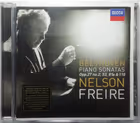
Beethoven: Piano Sonatas, Nelson Freire, piano
- Composer
- Beethoven
- Artist
- Nelson Freire, piano
- Label
- Decca
- Catalogue
- 475 8155
- Reviewed by
- Ruth Squire
Nelson Freire has selected an attractive set of Beethoven piano sonatas for his latest release: the Waldstein, Les Adieux, the Moonlight and Op.110 are all included on Decca’s new issue. The beginning of the Waldstein is by no means an easy ride for any pianist, but from the start Freire shows that he is in full control of the work. There is a delicacy of touch throughout this sonata and in the final movement he contrasts this with a great sense of power and determination, the melody triumphantly singing out over the lower passage work.
Les Adieux provides a sense of relief after the dramatic ending of the Waldstein, beginning with a delicate theme of “farewell.” Freire’s touch sparkles throughout this beautiful sonata. Take, for example, the final movement of this work, the passage work seems to happen entirely naturally, the scales sounding as though they may float away. The fugue at the end of Op.110 is impeccably controlled, proud and virtuous.
By comparison, The Moonlight sonata that follows is blissfully gentle, whilst not losing its sense of dreaminess. This dreamy state is but a distant memory by the time the finale comes around; Freire has captured the stormy passion here. I hope we get to hear more Beethoven from this wonderful pianist, frequently described as “one of the best-kept secrets in the world of piano.”
About the pianist
Nelson Freire was a Brazilian pianist, born in 1944 in the town of Boa Esperança, who began lessons at the age of three and made his first public appearance at five, playing Mozart. He won a grant at the Rio de Janeiro International Piano Competition in 1957 with Beethoven’s “Emperor” Concerto, and his international career, launched in 1959, went on to take in virtually every major concert stage. He was especially known for his decades-long friendship and musical partnership with fellow pianist Martha Argerich, whom he met as a teenager while both were studying in Vienna with Bruno Seidlhofer, and with whom he recorded and toured extensively throughout his career.
A note on this page
Originally published by Ruth Squire, recovered from mmmusic's own archive and reproduced here as the critic wrote it.
Questions about this recording
Which four sonatas are on this disc?
The 'Waldstein' (Op.53), 'Les Adieux' (Op.81a), 'Moonlight' (Op.27 No.2) and Op.110, a single-disc recital rather than part of a complete cycle.
How is Freire's Waldstein described?
The review notes it isn't an easy opening for any pianist, but that Freire shows full control from the start, contrasting delicacy of touch with real power and determination in the final movement.
What's distinctive about Freire's reputation?
The review quotes a common description of him at the time as 'one of the best-kept secrets in the world of piano.'
Is this recording still available to buy?
Yes, Decca's catalogue number 475 8155 remains findable through classical retailers. We don't run an in-house shop, so we link out to Amazon and Discogs below.


