
CD Review
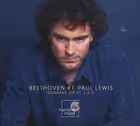
Beethoven: Piano Sonatas Op.31, Paul Lewis, piano
- Composer
- Beethoven
- Artist
- Paul Lewis, piano
- Label
- Harmonia Mundi
- Catalogue
- HMC901902
- Reviewed by
- Sandy Matheson
Paul Lewis has decided to start his voyage through Beethoven’s piano sonatas with the Op. 31 group, a highly innovative trilogy of works written in 1802, between the Second and Third Symphonies. By now Lewis will probably be quite bored with being compared with Alfred Brendel, his one-time teacher, but I suppose it’s inevitable. Quite apart from the repertoire that he chooses to play, his approach has much in common with Brendel’s; unexaggerated, dryly humorous and with formidable intellectual control.
His Op. 31/1 nicely captures the first movement’s character of “compulsive, but scatter-brained, determination” (Brendel), while his patient way with the finale of the Tempest sonata really pays dividends; although it is said to have been inspired by the sound of a galloping horse, Lewis’s tempo reflects Beethoven’s marking of Allegretto (and anyway I don’t think that this strange movement has got anything to do with horses). This Beethoven cycle is off to a fine start.
About the pianist
Paul Lewis is an English pianist and a protégé of Alfred Brendel, whose own recordings of this repertoire this disc’s original review measures itself against. Lewis went on to become one of the leading interpreters of the core Austro-German repertoire of his generation, in 2010 he became the first pianist to play the complete cycle of 32 Beethoven sonatas across a single BBC Proms season, and his completed Harmonia Mundi recordings of the cycle were later singled out by the New York Times as the single set it would recommend above all others. He was appointed CBE in 2016 for services to music, and has also received two Edison Awards, three Gramophone awards, a Diapason d’Or de l’Année and a South Bank Show Classical Music Award over the course of his career. Starting the cycle with the Op. 31 set, as this disc does, is itself a notable choice: these three sonatas sit at an unusually experimental point in Beethoven’s output, written directly after his famous “Heiligenstadt Testament” period, and each explores a different formal or dramatic idea rather than settling into a single fixed pattern the way some of his earlier sets do. Lewis went on to record the complete 32-sonata cycle for Harmonia Mundi across several further volumes, alongside recordings of the Beethoven concertos, Bagatelles and Diabelli Variations.
A note on this page
Originally published by Sandy Matheson, recovered from mmmusic's own archive and reproduced here as the critic wrote it.
Questions about this recording
Why did Paul Lewis start his Beethoven cycle with the Op.31 sonatas?
The three Op.31 sonatas (Nos. 16-18) form a highly innovative trilogy written in 1802, between Beethoven's Second and Third Symphonies, a natural, self-contained starting point for a complete cycle.
How does Lewis compare to his teacher Alfred Brendel?
The review notes the comparison is probably inevitable given the repertoire and his training, but finds real common ground: an unexaggerated, dryly humorous approach with formidable intellectual control.
What's distinctive about this account of the 'Tempest' sonata?
Despite the sonata's nickname supposedly linking it to a galloping horse, Lewis's patient tempo instead follows Beethoven's own marking of Allegretto in the finale, a deliberate, considered choice rather than a headlong gallop.
Is this recording still available to buy?
Yes, Harmonia Mundi's catalogue number HMC901902 remains findable through classical retailers. We don't run an in-house shop, so we link out to Amazon and Discogs below.


