CD Review
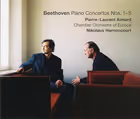
Beethoven: Piano Concertos Nos. 1-5, Pierre-Laurent Aimard, piano
- Composer
- Beethoven
- Artist
- Pierre-Laurent Aimard, piano; Chamber Orchestra of Europe / Nikolaus Harnoncourt
- Label
- Teldec Classics
- Catalogue
- 0927 47334-2
- Reviewed by
- Sandy Matheson
Pierre-Laurent Aimard has written a personal note to accompany his new recordings, entitled “Why another complete recording of Beethoven’s concertos?” The impetus to record them did not come from him, but from his collaborator Nikolaus Harnoncourt, who has already made compellingly individual recordings of the symphonies, the Missa Solemnis and the Violin Concerto amongst other things. He had made no secret of wanting to record the piano concertos with Martha Argerich; however, not even Harnoncourt could persuade the great Argentinean pianist to add the last three concertos to her repertoire.
Having survived the recent cull of Warner’s artist roster, Aimard has graduated from being a twentieth-century specialist to one of Warner Classics’ “house pianists.” His relationship with Harnoncourt has proved to be fruitful. Aimard writes that Harnoncourt’s views about integrating the piano into the orchestra chimed with Aimard’s aversion to “the preponderance of the solo instrument, which obscures many layers of the orchestra, and primarily serves the soloist’s ego.” In practice, Aimard and Harnoncourt interact like co-conspirators rather than rival popes.
Together, they make something altogether special of the extraordinary Andante con moto of the Fourth Concerto, the high point of arguably the finest recording of this work in recent years. In every concerto, Harnoncourt demonstrates a rare ability to generate enormous anticipatory tension in passages leading up to recapitulations, it’s noticeable in his Beethoven symphony recordings too. For example, listen to the relevant passage in the First Concerto (from bar 312), and check out Aimard’s electrifying double-octave payoff at bar 344!
Aimard has clearly thought hard about how to effect Beethoven’s numerous pedalling instructions on a modern piano. Listen, for instance, to the delicately veiled first statement at the outset of the Largo of the same concerto. Throughout the set, Aimard brings crisp attack, an ability to return Harnoncourt’s serves with interest (how many pianists could do that, I wonder) as well as a formidable technical arsenal, runs and trills are enviably even. The Chamber Orchestra of Europe, equipped with “period” brass and explosive, leather-headed timpani, make a perfect partner for Harnoncourt and Aimard, who comments that it plays with stunning perfection, impeccable style and an incomparable spirit. Indeed it does, and it provides a further reason to investigate these intelligent, freshly imagined recordings, which I strongly recommend.
A note on this page
Originally published by Sandy Matheson, recovered from mmmusic's own archive and reproduced here as the critic wrote it.
Questions about this recording
Why did Aimard record all five Beethoven concertos with Harnoncourt?
The idea came from Harnoncourt, who had already made distinctive recordings of Beethoven's symphonies, the Missa Solemnis and the Violin Concerto, and had originally hoped to record the concertos with Martha Argerich before turning to Aimard.
What's distinctive about Harnoncourt's approach here?
A rare ability to generate tension leading into recapitulations, audible across his Beethoven symphony recordings too, the review points specifically to the passage from bar 312 in the First Concerto's finale and Aimard's payoff at bar 344.
What orchestra plays on this recording?
The Chamber Orchestra of Europe, using period-style brass and timpani, credited in the review as a perfect match for Harnoncourt and Aimard's approach.
Is this recording still available to buy?
Yes, Teldec's catalogue number 0927 47334-2 remains findable through classical retailers. We don't run an in-house shop, so we link out to Amazon and Discogs below.


